Sunday, February 12, 2012

first snow (at the edge of the earth)


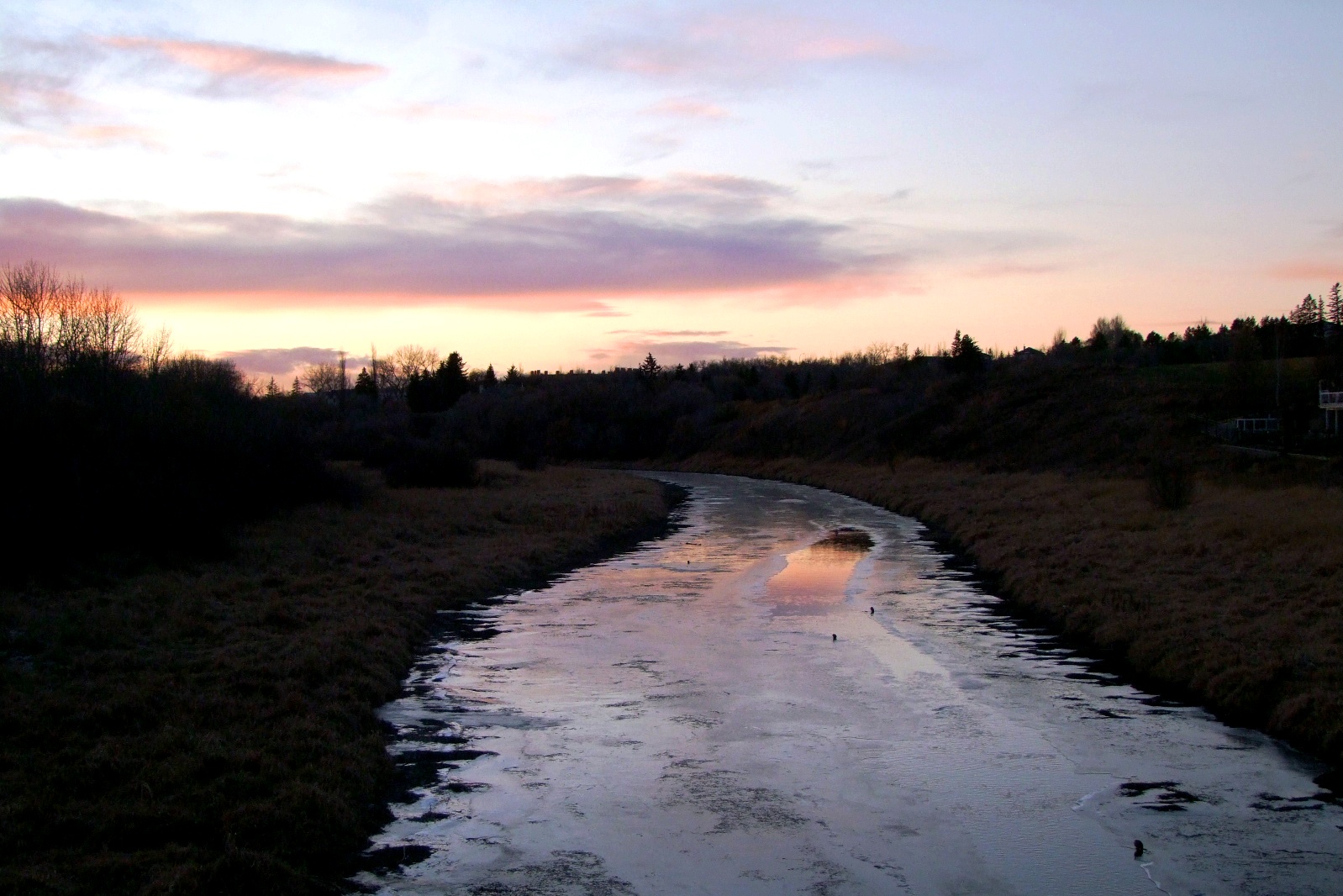
These were photos of the first snow at Riverlot, back in mid-November (and was probably some of the most snow we've seen this year at home, strangely enough). And that day I was thinking about my dad, and how since I'd been away he would always send me photos of the first snowfall. I always appreciated these little updates of what the earth was doing, faraway in my homeland.

He was never one for speaking much on the phone, so especially cherished these little notes of his, whether snapshots from the backyard or recent fishing trips or photos of especially cute Jack Russell Terriers or news snippets he'd come across that he thought I'd like to read. And opening my inbox now every morning I am constantly reminded of the absence of his emails, that I never see his name pop up amongst listserv notices and the daily flood of university tasks.

Perhaps even more strongly, I still feel a wave of grief every time there is something I want to tell him -- something interesting that I've read about fossils unearthed or deep sea fish newly discovered or antediluvian bacteria trapped in Antarctic core ice (shades of the X-Files!) or how the week after he died they found the feathers of dinosaurs trapped in amber in the southern coal fields, how they thought they'd finally captured evidence of particles moving faster than light. These are the things we'd marvel at together, and they remind me of his sense of wonder at the world; to not be able to tell him these things, share them with him, feels like waking up in the night and grasping around in the dark for something that can never be touched, isn't even there where you thought it was.

Last month I read Roland Barthes' 'Mourning Diary', a compilation of thoughts he jotted down on cards the year(s) after his mother passed away after a long illness. They devastate me and at once leave me with an immense calm as I find so much of what I experience mirrored there, raw and unapologetic, in this instance, the realization that there is so much I am never going to be able to tell him, talk to him about:

Feb 12th. Snow, a real snowstorm in Paris; strange. I tell myself and suffer for it: she will never again be here to see it, or for me to describe it for her.

I used to eagerly upload my fieldwork photos, and those from when I was first in Scotland, to show him these places where I was too, these places he would never see other than through me. To show him these things also comforted me, and sending him these things became a way of reminding myself, reassuring myself that this is what he wanted me to be doing; that I should not feel any guilt whatsoever at being away from him while he was ill. I wanted to create and discover beautiful things, and share them with him, as a way of showing him what his support for me could do. And so we were conduits for these little quotidian experiences, bits of knowledge, and this always connected us.

So much of grieving, and the aftermath of a death, is about renegotiating your relationship with that person. They still exist, but in a different form now, in a way that makes your brain try to grow tendrils in order to try to reach and wrap itself around this change of state and tense.

In the weeks after his passing, though, I had a dream, the first dream with him in it after his death. He walked into the kitchen like nothing had happened, and I rushed over to him and I was crying in my sleep, holding on to him, telling him how much I missed him. He told me not to worry, he was doing fine, and I asked him, had he heard about the feathers in amber? And he said, no he hadn't, yet, but he was going to remember that, read about it later. Let me just grab a pen and write that down, he said, just like he always did when he asked me about something, so he wouldn't forget the details. And certainly, I know that I still can tell him things, tell him whatever I want -- but I have so much trouble handling the fact it still feels like a monologue. I don't know yet how he can respond.


Saturday, February 04, 2012

on these legs

Self-portrait in the fields at the edge of the earth, Nov 2011

This evening, I am so tired, and lately I feel constantly reminded that I have been under so much stress this year, that the fatigue still hasn’t quite seemed to lift. I feel irked, because sometimes my body does this, gets uselessly tired, but refuses to sleep at night and then begs for naps by mid-afternoon.

Such a strange body, sometimes. Often it’s my body’s inner workings that frustrate me – the heaving, knotted tangling of my guts when my digestive system malfunctions, the sudden, insidious stroke-like misfirings of my neurons that bring the pain, nausea and incoherence of migraines.

Other times it’s my appearance. The way I am too bony in places, too lumpy in others. A face too soft-featured, indelicate, and plain. Pale as a white whale, but with dry skin, freckle outbreaks, and incorrigible body hair.

Being annoyed with my body directly translates into a generally unpleasant emotional state, just as less-than-stellar emotions bring pain felt in all manner of ways. Anxiety that I feel nearly constantly sometimes pervades every part of me – during a nearly year-long period of intense anxiety when I was younger, I ate hardly anything, because I felt such tension and blockage in my throat and windpipe I worried I was constantly about to choke.

But what I am trying to express here is that I don’t want to feel negative about any aspect of myself—because there is no such thing as dualism despite what Descartes says, don’t listen to him—and I am always trying to reconcile the way I’d like to think about my self and this body that I don’t just dwell IN, but exist AS. This is the only form I know, and I am grateful that I am living.

While running the other day, I was feeling my leg muscles creaking and searing in the damp cold, and I remembered something my dad said to me this summer, one time while I waited for him to muster up the energy for me to help him walk upstairs. I was sitting on the floor, stretching a bit, and he observed, “You know, you sure have Ferguson legs, my legs”.

And I looked at them, the ones everyone in track called ‘turkey legs’, because they weren’t as skinny as the long-distance boys’ efficient chicken-legs, nor as long and shapely as those of the other girls. Thin little forelegs under massive thighs, with patchy hair and an uneven tan.

But now I focused not only on the taut curve of the quad and slimmer slope of the calf, but tried to really feel them as I stand up, each joint and sinew unfolding, blood rushing through the hidden webwork. They are so strong, and they carry me well. “Yes, they’re good ones”, I say to my dad, and I help him up to bed.

I think of his legs, then, swathed in his grey sweatpants that seemed to become more and more voluminous. In the hospital, I massaged his pale, swollen feet and calves that could never stay warm, the limp ghosts of legs that cycled and walked daily not so long before, that once led me high up into the mountains and later followed me along those same trails.

And when I was running, North Sea sand under my feet, straining in the wind, I felt something of my father in my legs, a current running from the depth of the muscle and springing into the earth. And there was pain and there was lightness, there was an energy that comes from the remembrance of power, and I felt I was honouring him.

I need to be good to myself, my body, and see every part as a gift, be grateful for it. All of the aches and discomfort within it, the strange outer aesthetics and my ambivalent feelings about them.

I have his skin, his colouring, and it is on his legs I run. I am physical pieces of my father left on earth.

Thursday, February 02, 2012

tops of birches

Kirsten Everberg: White Birch Grove, North (After Tarkovsky), 2008

White Birch Grove, North (After Tarkovsky), Kirsten Everberg, 1998.

***

Tops of Birches


as though
nothing changed:
oh
stillness--after
whispering
gazing
and hearing--


(and i forgetting it was life long forgetting the past voiced as a cradle song so as to remember the rest of life the lullaby with its silent-originary spirit primal opening of me a widening it promisingly freely without limit)


oh
stillness--(long time already there is no one):
the air--among the tops:
of birches


(1983)


more about Gennady Aygi (Chuvash poet, writing in Russian to survive) here
also, lovely essay by one of his first English translators

Monday, January 23, 2012

as love is, home is (erin mouré)

local foxtails in a local field, taken on solstice, dec. 2011

(Dear blog, I am sorry for neglecting you! Sometimes months go by. I still haven't finished my autumn chronology of photos, but soon...)

Mostly I just want to exclaim with great anticipation over Erin Mouré's new book, which is currently finding its way over the Atlantic to me; I vaguely knew it would be appearing, and that it dealt with her mother's childhood emigration from Western Ukraine, but I found her blog about the book the other day and it brought me such excitement I ordered the book immediately.

It's a little collection, this blog, of excerpts and related links, parts of the process of the book coming together, and already I cannot wait to immerse myself in her narrative(s). It's a book-length poem, her mother's story of 'coming from nowhere', from a place caught between the Ukrainian and Polish borders, complicated by wars and top-down struggles of exclusion/inclusion that didn't mirror the way her people felt. I am just so excited that it examines the idea of the 'local' -- tuteshnyj, in Ukrainian -- that is less about ethnicity and more about the belonging to a place, to a community of people (of beings, of entities) which is something that needs to be examined deeply and seriously, especially in this part of the world.

(if you read nothing else on the blog, read this bit -- this is the essence)

She alludes to the violence caused by ethnic and religious labels, of the various ruling powers' (Austro-Hungarian, Polish, Soviet, Ukrainian) need to categorise and create not only physical but mental, emotional borders between people, and how this was so utterly destructive. From a family considered 'half-Polish, half-Ukrainian', she discusses the trauma that this caused her grandparents, and the dismissal she even received recently about her 'ethnic heritage':

Although today’s independent Ukraine is still rife with confusions and the need for new historiography that fully admits all parts of its past (imagine here: the professor in L’viv who eagerly asked me my family name then responded flatly and without interest “that’s a Polish name,” effectively expelling me again from national territory that is just as much mine as it is hers), it does now include as its citizens everyone who lives on its territory. All, today, regardless of background, are Ukrainians. And I am half Ukrainian, of the Hamulyaks of the earth and of the Hrandyshi of the air, the tuteshni, the people “from here.” I come from people of the Ukrainian earth who trade with and recognize the legitimacy of all the peoples.

(Erin Mouré, Here.)

My own family's story is a little bit simpler, at first glance -- they lived much further away from the Polish border, in a town 'overseen' by Polish landlords but there did not seem to be such tensions between the two 'peoples'. I've heard other families from the area arguing about whether their names are 'Polish' or 'Ukrainian', but in my family it seemed less contentious -- my baba identified herself as Ukrainian, mentioning Hutsuls and Boikos (Ukrainian 'subgroups', according to ethnographers, and another issue in itself!) as what her people were often called locally ("but there were many Polish people, and Jewish people too" she said), and maybe it's because her own mother's family had Tatar ancestry and she married my grandpa who carried an old Czech name, but Ukrainian-ness itself was not something she mentioned much. The nationalist aspect didn't seem to interest her much.

(On my grandfather's side -- also from Nebyliw -- there was more tension, but in terms of religion, not so much ethnicity, with Eastern Orthodox and Jewish people being forced to 'convert' to marry Greek (Eastern) Catholics, causing some rifts when children of the 'converted' decided to take up the other faiths, etc. But I don't know the full story there, it's only becoming unearthed as of late*)

What struck me more was the way she referred to the place she was from. She didn't talk so much about 'Ukraine' -- after all, that wasn't so much what it was called when she lived there, other than for a few brief years when she was very young -- but of Nebyliw itself, her village, and of the Old Country.

In fact, one my earliest memories of this is from when I was about 4 and I was playing with my globe. My dad had been teaching me country names and I was just learning to read so I was trying to identify them. I searched and searched, but got quite frustrated and indignant when I couldn't find 'The Old Country' anywhere on the map. "But that's what she calls it!" I said to my father when he laughed at me.

This reference to the old and to the new made it seem to me that it was less important to her about being from 'Ukraine', the imagined community, but rather, it was this old country, from Nebyliw, that physical place, where there was a community of people who spoke at least three different languages and herded cows, and sheep, and planted crops and brought fish and eels to the nearby market in exchange for salt, and ran logs from the mountains down the Lymnytsya river.

And so I am eager to read the story of Mouré's mother, and the village of Hlibovychi Velkye, to better understand these border stories, the way her family experienced the local, the being from here, in a place that saw great turmoil and great tragedies. It heartens me that links to this site about a whole project aiming to research Ukraine from a non-nationalist point of view (rare in the post-Soviet regions, let me tell you!) and it gives me hope for new ways of analysing and understanding this place my own mother's multifaceted relatives came from, and understanding what I have inherited through my family's fraught history, and understanding what place meant to them.


*I also wish I had asked my own baba more about what happened in her village in WWII (it was a site of combat in WWI, when her own father died, and sometimes families were split by the border of fighting for Austria-Hungary vs. fighting for Russia), but they left shortly before things got really awful in Western Ukraine, and I wonder how much she really knew, what her relatives told her. I know some of her relatives helped hide some people from the Galician SS and from Stalinist purges at various times, but again, I don't know the whole story. (This is another reason that Everything is Illuminated destroyed me especially thoroughly, knowing that such things likely happened there too, in Nebyliw, to my relatives).


Monday, December 05, 2011

muskrat party no. 1

This is the Sturgeon River in early November -- at sunset, with the first ice film glazing the still water, like mica-isinglass, the brush and sedge bleached and bowing low towards the water.


When I took these photos, the muskrats were still very active, swimming to and fro near the bridge...


There were only narrow, frosted edges of ice flanking the slow current, and the little muskrats would clamber gingerly out onto the platforms to nibble on shoots and riverplants before heading into the water again.

(This evening, the moon was full and the sky pigeon-grey)

(Small luminous pearl in the aspen-corals)

Around sundown, great numbers would gather in conferences, washing their paws and smoothing their whiskers, but never getting tooo close to one another (I did witness one muskrat-squabble, it involved snorting and splashing).

And perhaps they admired the last light illuminating their water-slicked, oily fur...


They swam like winter was approaching, busily plucking plants and traversing the channels beneath the ice sheets -- it was amazing to watch them swim beneath the translucence, the murky green water pressing up against the glass, their webbed feet pushing off the film, following the trail of water bubbles as they slipped into their bankside nests.


Muskrats don't hibernate, rather they continue to slip out from their tunnels into the flow beneath the ice to find decaying plants and small mud-buried larva; though we won't see them until the melt comes, they will follow the same water-paths under the frozen surface all winter.

They seem more at home beneath the surface than above it -- it was the muskrat, after all, who dove down in many Algonquian and Iroquoian creation stories to fetch the earth from the bottom of the great lake in order to create the land, when all the other animals had failed.

Saturday, December 03, 2011

autumn chronology: beginning of november, riverlot


* * *

After great pain, a formal feeling comes--
The Nerves sit ceremonious, like Tombs--
The stiff Heart questions was it He, that bore,
And Yesterday, or Centuries before?

The Feet, mechanical, go round--
Of Ground, or Air, or Ought
A Wooden way
Regardless grown,
A Quartz contentment, like a stone--

This is the Hour of Lead--
Remembered, if outlived,
As Freezing persons, recollect the Snow--
First--Chill--then Stupor--then the letting go--

(emily dickinson)

Wednesday, November 23, 2011

ways my father did not die

field grass remnants, riverlot, early november 2011

* * *

(poem re: two nightmares, and the fact that when he dies in them, i can't wake up and tell myself that it was just a dream.)


ways my father did not die

it was not as it was in dreams:

not hypothermia, not from the cold

water seeping into the cloth that

bound his feet – he did not walk


miles and miles to the hospital

through icy pools sprawling malignant,

to die with the dark winter light

on the inside of his eyes –


brighter than that medicinal fluorescence,

than the room where we unwrap the

layers, strip his body like a sodden onion

but find him not there –


he did not die as in the second dream:

on the side of a mountain road,

gravel digging into my knees

with each spasm of his back –


his arching body contorted

like a trout diseased and whirling,

bent nearly to snapping, trying

to shift shape out of this –


to a fish to a bird to anything

that could relieve him of his

aching form, leaving me with the

pulse of absence in my arms.


i was not there. i can only believe

what they told me, that it

was swift, that he shifted away

in a last exhale that still hung

mist-like over half-lidded eyes

when we came in the early morning.


i will never know what he was

thinking. if he knew it was coming,

that silent white meteor

searing through the window, stealing

his gaze, leaving his quiet head

slumping towards the door.


i do not dream of how it

happened really: not of the day before

when i brought him blankets

and the paper, warmed his feet


and kissed his whiskers,

brought the smallest bites of

his last dinner to his lips. and

i will wake and wake again


with the ache of these remainders,

of these ways it never happened,

of the dreams that are not only

though they cannot change the dead.

Thursday, November 17, 2011

my father's house


geese gathering over the woods and the house, early november 2011


* * *

my father’s house is gone

and all the houses in his town

have crumbled [...]

and what will be ours

to do today

is to name everything we see --

after what we are

and who came before

and the things that run in fear

from you and me...

* * *

--from 'there will be spring', by bonnie "prince" billy, on the album wolfroy goes to town

(download and listen here. til nov. 24)

Wednesday, November 16, 2011

grief.


whitetail. (poem sketch)


it is autumn, and he is missing. leaves

are falling, and he is not there. you

look for him in the drying clink of summer

coppers, their hollow-throated rattle, the

pecking of a flicker, search


the leaflessness for pulses of rose-hip,

an intermittent semaphore of chokecherries,

reddened eyes of the crane—you cannot stop


the shining plain of grief rising

inside you, a shoulder-blade sharp

and jutting, like under the soft skin

of a stalking animal,shifts with a

pained loping amongst bloodless grasses.


always a presence, there in the field,

waiting—for the sky’s empty weight,

falling from bent branches in the chest,

settling on the thin limbs of lung

those clouds, marrowless.


you have seen in these trees

what we are made of: sinewy nests

strangling each joint as grief attaches,

makes every breath ache. reminds us

that what connects us, moves us apart.


further and further between the birches

the last sunlight in your fingers, division

made visible. always reaching


for something that can never be touched:

grasped not with your hands, your mind,

not even in language. like the deer

disappearing, boundless into woods at sundown,

leg-splaying leap and soundless landing –


(o maybe if you are really quiet,

really still, he will come back to you)


no. just a whitetail brushing the air

with anxious snow, vanishing flag

in the aspens, absence.

Tuesday, November 15, 2011

autumn chronology: mid-october, lower riverlot

the bright sedges by the river, sky still blue

cloud reflections in the beaver-dam stillness

shadowy muskrats, or perhaps beavers...

beaver, i think... i never got to see the tails...

in the nearby field, the old barn...

oh hello whitetails

the luminous skeletons of asters
hay-roll detail in the fading light

wandering

the moment of saturation warms me every time

Monday, November 14, 2011

shop sale

vintage carnelian and coral beads from ukraine, on various textures of brass chain

A wee note to say that recently I have added a few more necklaces and such to my shop of stones on Etsy -- and that I have a sale there, 20% for the rest of the month.

To get the discount, you just put in the coupon code SNOWFALL when you check out and the deductions will be made from the regular price.

Canadian shipping is free (SHIPMEFREE is the code) and if you want local delivery for your treasures, it's IMLOCAL. Perhaps you will find something to brighten your November?

Tuesday, November 08, 2011

autumn chronology: thanksgiving, riverlot

gold sea in the treetops

bright kalyna

mushroom mushroom

small flecks and pulses

aspen trembling copper on the blue sky

stacked hay pillows

freshly harvested field

cut wheat spindles

the gold and the red
golden fluttering

shy chickadee