Saturday, February 16, 2013

brain chemicals: why i take medication, part two of two.


aberdeen, early morning haar-fog, may 2012

By this point in my life, I have gone over these events exhaustively, and I can’t seem to figure out what triggered this period in my life that made me decide to try medication. No one stress seemed so monumental that it could do this to me, it was everything and nothing. And it was something that I simply could not seem to muster up the will or strength to do anything about, and after nearly four months of it, it did not seem like it was simply a season in my brain, like other intense periods had been.  And now I could not do anything, and I wanted to not exist any more, which also catalysed further anxiety, and that was what made me decide that psychotropic drugs were probably no worse than what I currently was feeling. I was in the strange state of not wanting to exist, but not wanting to not want to exist; I felt like I had nothing to lose.

Again, at this stage, I was lucky. Lucky to have such an understanding psychologist, and a doctor who was patient with me, and warned me that I might have to try a few different medications to find one that helped. And I did try a different drug, before I tried the one I still take; it was one that made me quite ill right from the beginning. It made my frenetic thoughts slow down, but to the point where I couldn’t think at all. I went from highly anxious to strangely dulled, depressed. I remember one day when it seemed to only allow me to think about how I could hear the blood in my veins, and that the raindrops on the windows sounded like they were amplified and slowed down. I was nauseous constantly, and this was simply not feasible. So we tried something else, and I was tremendously lucky in that this one just fit. The first week was rough, but all in all, it happened quite quickly. There were side effects, but they were better than how I currently felt, perhaps even a welcome distraction, and so I continued.

Over the next two months, my thoughts slowly returned to something more normal for me: I could think clearly again, precisely enough to replace my incessant mantras with more sustainable CBT. I could better tell when my thoughts were  I stopped shaking, and panic attacks dropped off and I could do things, venture out, do healthy things. I could distract myself not with sharp things but with productive things to do with my hands. In essence, it simply allowed me to finally properly do the work I needed to do in order to deal with the anxiety I was feeling, before it got so bad I could no longer even think about doing anything. It allowed me to be clear and functional again, enough to cope. 

It was not perfect. It still isn't. Most of the side effects have faded, but some linger at times. I am afraid of running out, losing my pills; I can't forget to take one or I feel it immediately. But this is still many orders of magnitude better than what I was feeling before, and so I deal with it. Through a lot of experimentation I've found the dose and the timing that seems to be optimal for me, and I go with it, while trying as much as I can to do all the non-pharmaceutical things I can to stay healthy. 

Because I still get anxious, as I said; I still feel depressed. I have bad periods, very helpless-feeling, unproductive, waves that I have to get through. But these, while trying and unpleasant, are things I feel that I can deal with. They are something different than the pure terror, the neuronal storms of nonsense and inability to think. They arise from things I understand, most of the time, so they feel like something else. And I know that it could be argued that my brain with its faulty substrata predisposes me to have certain kinds of reactions to things in the world. This is not unlikely. However, I feel there is such a distinction between feeling depressed and anxious due to the state of the world and my place in it, the forces acting against me that I ultimately cannot alter, and feeling anxious because I am having paranoid, terrifying, irrational thoughts that I still recognize have no basis in reality. I am not trying to artificially separate the kinds of anxiety and depression I feel into purely chemical and purely situational; I am not trying to uphold the harmful Cartesian duality of mind and body that I think is one of the sources of the denigration of mental illness. That the medication seems to help one strain of anxiety though, and not others, though, suggests to my non-neurologist self that perhaps  there are different (but connected) kinds; the kind that stems from my brain structure, and the kind that starts from outside of it but I experience and process (of course) through my neuronal set-up. Maybe they are far too entwined to fully separate, and interdependent in myriad subtle ways; my reactions to the OCD-like thoughts certain do shape my reactions to situation-based anxiety too. I don't fully understand it yet, but I keep trying to. For now, I just want to acknowledge that some of what I feel is traceable and comprehensible to me, and some of it arose without such triggers; and the latter is what I find the medication helps.

It didn't magically restore my self-esteem, make me fearless, a better writer, make me love myself unconditionally, flood me with optimism. But it also didn't erase my personality and turn me into a mask-wearing zombie with stunted, inappropriate emotions, nor a shallow, uncritical consumer. It did let me feel more than constant anxiety and panic, though. That was all, and that is what I wanted.

*

I know, though, for some people, these kinds of medication make them feel horrible. They do feel like blank, stumbling automatons, just as clouded and fuzzy as they do while depressed, numbed and dulled. We know that for whatever reason, these medications are temperamental and finicky and quite unpredictable (just like people’s brains).  For some reason, what helps one person’s anxiety or depression does little to nothing for (or seriously worsens) another’s condition:  I’ve heard both just as many completely terrifying horror stories as accounts of neutrality or ineffectualness as I have successes. And I wish I knew why this was, wish we were at that point with neurology to have an explanation, but we aren’t. We still can’t always discern the messenger from the message, the excess from the essential; why some people’s brain waves look really different from other people’s even while in very similar states, why this drug I take that they thought would be good for epilepsy (but wasn't) might be good for depression (sometimes, it seems) would end up helping more people with generalized anxiety and obsessive-compulsive disorder (it did for me, anyway). 

Perhaps all this speaks to is the incredibly individual natures of our brains, perhaps more so than any other part of the body.  One issue with allopathic medicine is that it wants to assume that all human bodies are essentially the same, rather than specific systems, I feel; and perhaps the fact that not all anti-depression and anti-anxiolytic medications work on every person’s issues  I would hazard a guess that my brain chemicals were perhaps quite responsive to psychotropic medication because I seem to be pretty sensitive in general to any kind of chemical interference; sleuthing out the triggers of my migraines has made me realize that the foods I put in my body have a massive and often immediate effect on how I feel. Therefore, by fastidiously avoiding those foods and supplementing my diet with a concoction of vitamins does a lot toward making my migraines less frequent, because I seem to be pretty chemically suggestible.

I suppose it would be wonderful if I could find a vitamin-potion/food combination that did the same for my anxiety and depression. I’ve tried a lot of different combinations, both through my own research and seeing a naturopath, too, and I continue to try things even though I take pharmaceuticals. But unlike with my migraines, I wasn’t able to find anything that could stave off two breaking points. And that was when I decided (both times) to initially go on my medication, and to continue it after a hiatus. I was doing all the good things that they tell you to do with mental illness: to eat properly, to take the vitamins, to exercise. And that helps a great deal, but not enough for the worst bits, unfortunately.

Now, I did manage to get through a number of difficult stretches without any medication; the OCD-like periods, some of the self-harm. Sometimes I wonder if I could have handled my most serious breakdown that way, if I could have pulled through it too. I realize that many people do go through very similar things without it. And well – I didn’t. I did what I felt was best for me at the time, the only thing I felt I could manage. If that makes me weak, then I suppose I’m weak, but I’m alive, and I can deal with the periods of depression and anxiety that I still go through because at least I am not contending with that terror I could not will away on my own. I still struggle with doing a number of things, but I am far more productive than I ever could have been without it, I feel. This leaves me with the extra energy I need to deal with what the drugs do not touch.

Everything that I’ve written may just read like elaborate and desperate justification for my medication; so be it. For me, it is a potent reminder for when I start to criticize myself, for when I start to think that I am wrong to have started the drugs in the first place. I completely understand and respect why someone would never want to touch a psychotropic medication, as I've been there. I just happened to eventually change my mind. And if that makes me just another brainwashed, ‘addicted’, misguided consumer who will take this medication for the rest of her life, I suppose that is how it will be. I just want to be fine with that, to openly acknowledge and explain why I did it, and through I may always struggle with it, I also want to be able to freely acknowledge that I’m grateful that there was this option available to me. I'll settle for being weak, but functioning; for whatever the anti-psychiatry movement wants to call me, but alive.


 

Friday, February 15, 2013

brain chemicals: why i take medication, part one of two.

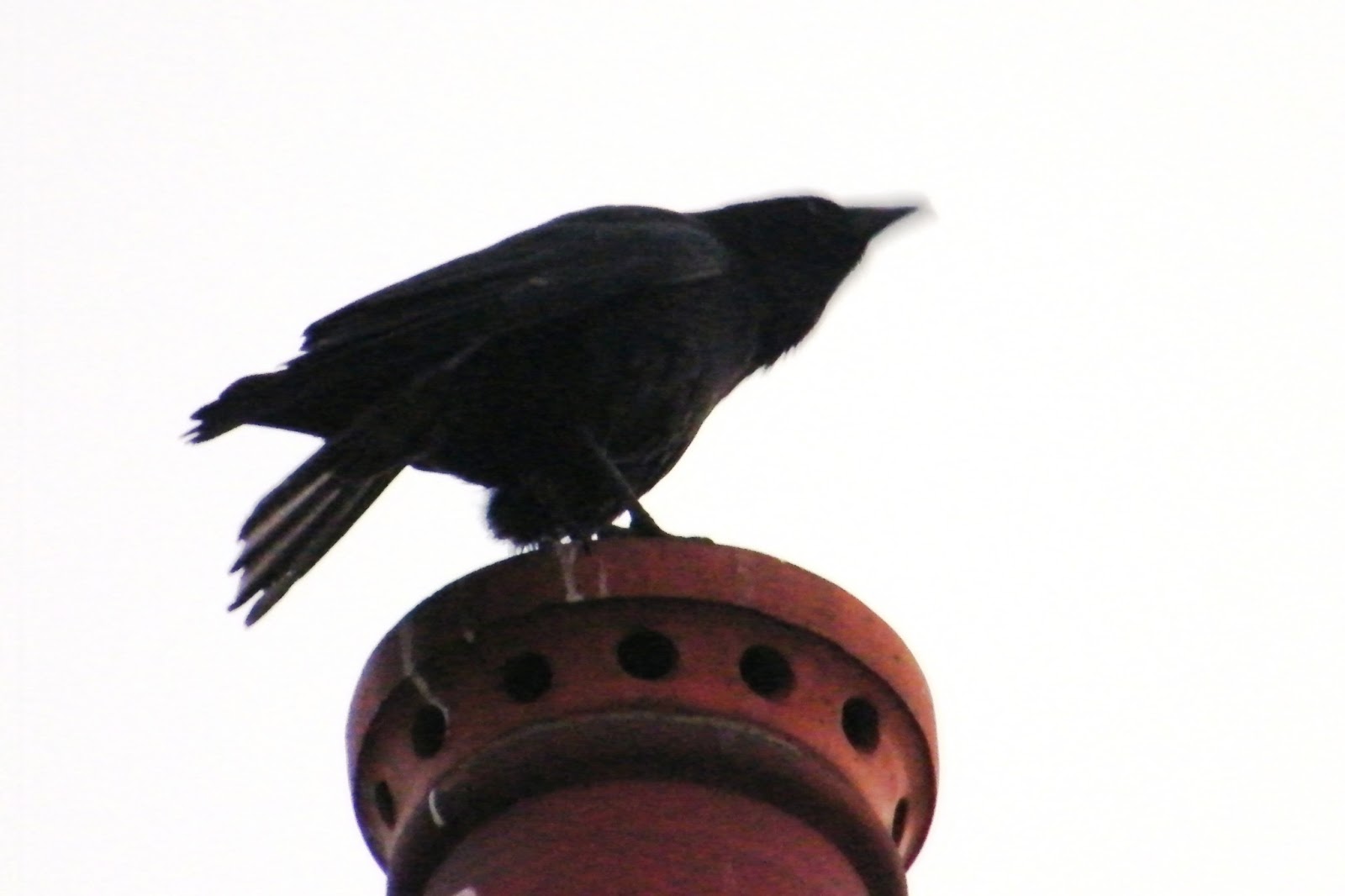
raven on a chimney, early morning Aberdeen, May 2012

*

I have never liked taking medication. As a young child I had to be bribed into it, because early experiences with penicillin made all medicine have pretty unpleasant associations, as did bad reactions to decongestants and cough suppressants. I remember tolerating the one penicillin that didn't  wreak havoc on my system, the infamous 'banana medicine', but that was it. I learned to accept that ibuprofen could do fine things for a tension headache, and take a few hours off a migraine even if it did nothing for the pain. Half a dimenhydrinate makes nausea evaporate. But I was always (and continue to be wary) of what was going into my body because of the element of the unexpected, the understanding of their power, and I still am. I remember learning in biology about the load many medicinal substances place on the liver and the kidneys, and I worried about my body's ability to handle these substances; I understood that it should be fine if drugs are taken sparingly, but what about something you take every day?


I do agree with many opponents of psychotropic medications; I think it is terrifying that you can walk into a doctor’s office and blithely ask for an anti-depressant or anti-anxiolytic of your choice; this has happened to me and a number of others. I want these drugs to be available, but I am concerned that many doctors really know little about them, because from my experience and stories I've heard, patients are rarely told about the trials and hazards of going on and off medication (or that their concerns are explicitly dismissed or downplayed). They can have very serious side effects and consequences and should never be taken lightly or without a lot of consideration, because they cannot be discontinued abruptly. And most definitely they can be worse than reasons why you're taking them; I have no doubt about that. But that doesn’t mean they’re worthless and should all be condemned, as they can be very effective.

I thought about providing links to medical studies and articles both for and against anti-depressants, but frankly, it's pretty easy to find these sorts of back-and-forths everywhere online, by psychiatrists and other clinicians as well as those who have experienced the drugs. Yes, it's true that we know very little about the brain as a whole, and also only a very small bit about what causes mental illness and about the mechanisms of these drugs we use to treat it. However, I just can't understand how anyone can make the leap to 'these drugs are no better than placebos' just because it is not precisely known at this point in time how and why they work. Some brain chemical imbalance theories may be outdated or (partially) debunked, but we do know that somehow these medications, these chemicals, can bring relief to symptoms by affecting the function of neurons. They did something for me.

I feel awkward writing this, because I really don't want to dismiss the fact that others have been miserable on them, and have found their conditions to worsen and become more debilitating. But I am also tired of having to downplay or deny my own experiences-- especially since it was not an easy decision for me to make, to take these drugs in the first place. I am tired of the subtle but insidious judgment that comes from taking them; the misunderstanding that it's a cheap and easy way to 'happiness' makes me seethe. I have done a fuckload of work to be able to function, before and after starting this medication. This is not the easy way out. I do not take these to be happy. These do not make you happy. I am not happy all the time. I sought out this treatment because I could not feel anything but pure terror and I wanted to have other feelings. I still get anxious. I still have periods of depression. But now I can have more than one feeling. Now I can deal with these things, most of the time. 

* 

I don't know where my anxiety comes from. I don't really know if this predisposition comes from brain chemicals, even though I use other chemicals to help fix it. I think a lot of it comes from my brain, though, and I have memories of anxiety and panic for nearly as long as I have memories at all. It's been with me for a rather long time. I had a very un-tumultuous early childhood, with attentive and supportive parents, but I could really having a full-blown, hyperventilating panic attacks that came out of nowhere. When my dad found me crying and shaking on my bedroom floor, I didn’t know what to tell him. Even then, I realized that if you were upset, there had to be a good reason to be so upset – and it terrified me that I had no such reason. I made up stories; I told him that the girl next door had been mean to me. (That happened sometimes, and made me anxious too.  And I knew it was okay, it was normal to be upset about that, because that was a thing that happened. It was real.)


As I got older, I developed many more persistent anxieties. Some of these things were because of things that actually existed in the world, things that make many children anxious (being harassed in elementary school, etc.) and others, were not so rational, and definitely not so external. This duality that I could see developing in hindsight tells me something, too -- that in some ways, my anxiety and depression is Janus-faced: some of stems from my responses to my social and environmental factors, and yet some of it arises within my own mind, for reasons that cannot be traced (despite years of therapy). Many people, like Ann Cvetkovich, write that depression is 'the symptoms of a response to a fucked up world or a fucked up life' (see Depression: A Public Feeling, p. 15) and I do agree. I still get anxious, I still get depressed, even after a decade on psychotropic medication. However, when I look to the causes of this anxiety and depression, I can generally always link it to something in the world, in my life, that is shitty. Because there are awful things, both great catastrophes and daily microaggressions that build up and weigh us down. (And honestly, I find people who do not react to kyriarchal oppression as a little suspect, because things are pretty dire). I think anxiety and depression are completely normal responses, to certain things.

But then there are these other things, things inside my head. They can be exacerbated by less ideal conditions in the world, but they feel so internal, so idiosyncratic that they seem to come from my brain. Like my migraines can be triggered by things I ingest or by conditions in my environment, but also can just spring up from no traceable cause, so can my anxiety. And this is the kind that led me to not be able to function. The symptoms of this kind is what I like to remind myself about when I want to stop taking my medication.

The panic attacks that came on in class suddenly, that sent me running for the washroom often at school to hide there, because I often couldn’t explain what brought them on. And even if I could, it was a thoroughly awkward thing to do. And when not feeling that dizzy wash of fear, the accelerating breathing, the crush in my chest, I felt a constant tightness in my shoulders, a constricting mass in my throat, a vague nausea nearly every morning. When I was 10 and 11, there were times when I could hardly eat anything, terrified I would choke on each bite I took. I was underweight, my blood pressure was low, and my resting heart rate sometimes spiked up like a terrified rabbit until I thought I would black out.

There was the kind of anxiety that made me feel as if I was going crazy. It crept up for no reason. I deeply feared  losing my mind, forgetting who I was, saying and doing horrible things. I don’t know where those thoughts came from, what they arose from, what brought them on, but they definitely felt different than the other things that triggered anxiety, the people, the situations, my fears about things actually happening in the world outside of my thoughts. In high school, when I began seeing a psychologist, she helped me understand I probably had a mild form of obsessive-compulsive disorder (my sister and uncle have been diagnosed with a severe form of this), because I created rituals to assuage the anxiety: I washed my hands often, til they bled, not because of germs but contamination by frightening thoughts. I repeated phrases to myself over and over, mantras before I slept each night, a certain number of times, to make it so that everything would be okay. Looking over notebooks I kept at the time, I see pencilmarks in the margins tearing through the pages, fervently underlining the magical words I needed to write to prevent these awful thoughts, to straighten them out, to keep them in check.

As I got older, some of these rituals fell away. But when the tension in my body was too much, or I had a panic attack where I couldn’t stop crying, I learned to dig my fingernails hard into my palms. This sudden pain caused my focus to shift, and provided a momentary release from this internal intensity; it led to me scratching harder, and eventually cutting my skin – little vents for the anxiety, sort of like trepanning but for my flesh instead of my skull.  It helped at first, but eventually caused me greater anxiety for doing it, especially when I confessed it to others and received little empathy or support. This is when I started seeing my psychologist, because I was at a loss as to how to deal with this (I once had believed everyone dealt with anxiety like this, but trying to explain my feelings to others had come to understand this most likely wasn’t true) and was becoming afraid of myself in a way I could not handle.

With my psychologist, I engaged in Cognitive-Behavioural therapy, to help me deal with the moments of intense anxiety and the panic attacks. And so they still came, but I learned to manage them better, to fend them off as best I could without resorting to cutting or burning. She always told me that medication could be an option if I decided I’d like to try it, but we would work without it unless I asked, and I was still very much against it.  And I was doing fairly well managing with the CBT for awhile, but then things started cropping up again. Near the end of my first year of university,    I wasn’t particularly stressed about things in the world, external things; I was managing the new routines and workloads fairly well.

Then one day I had a very severe panic attack that coincided with a migraine that sent me to the hospital, and I was convinced I would die. The headache and panic attack subsided, and then a few days later I woke up with another one. And another one, and then suddenly every moment felt like constant anxiety, more continuous than it had ever been before; panic attacks were mere spikes on a high plateau of frantic unease.

It felt like my thoughts had aphasia; they came out in chunks that raced around and I felt nauseous trying to round them up. I felt lost in my own head, unsure of how I would ever make sense of anything again. The OCD-like fears returned, mantras were needed, but sometimes they were not even enough, and my mood began to sink when I realized that I really could not even trust my own thoughts anymore. I wanted to practice my CBT techniques, but I could not slow my thoughts enough to do so, could not even begin to do it no matter how hard I tried. Walking around the block, let alone running, was too terrifying, so I could not clear my head that way, feed myself the endorphins I hoped might help. Eating became difficult again, and I lost 15 pounds in three weeks. I would wake up shaking, convinced I was going crazy and/or was going to die. Nothing could convince me that I actually wasn’t.

I would have panic attacks that seemed to only subside when my body was too tired to keep shaking, too dehydrated to cry any longer; I then became afraid of always having a panic attack. When I wasn’t awake and worrying, I often had terrible nightmares, chaotic and violent; in the moments when I would wake from them I had the most scrambled thoughts, and it took all my energy to sort things out in my head enough so that I could get out of bed.

School term was over, I was working but kept having to miss shifts or leave early because I could not focus. Functioning was a little difficult though I tried so hard to not let on what was happening inside my head, and then I would feel worse because I could not function. But one day in the moments before waking I had by far the worst dream of my life, and I thought it was real, and I woke up and a cascade of thoughts started and I can’t even begin to explain it, can’t even type it out, could never even speak a word of it to anyone, but suffice to say that my shaky traitorous brain took about three seconds to convince me that it would come true and I would do a horrible thing and I was so fatigued and so tired that I had no energy to even summon up one of my spells to compensate for that hideous thought that I had another massive panic attack and decided that I needed to die, to not exist, to not be anymore.

I can’t express these thoughts very eloquently. I wish I could. I write them out and they feel suitably frenzied, but I do not know how to convey the terror and sickness I feel when I think of them, remember them; I can’t seem to capture it on the page. But this is why I decided to take medication. I can’t do justice to the lows I felt that day, I could not even calm down enough to speak until later that day when I went in to see my psychologist, and that was when I told her that perhaps I would like to try something, because at this point I was willing to try pretty much anything, frankly, that could even possibly make these particular feelings stop, because they were not really compatible with living anymore, and I thought I still wanted that.

So that, in a hastily explained, incomplete nutshell, is why I take medication for my anxiety. Not for the kind that comes from living in a problematic world and having feelings about it. Not the kind that is linked to my self-esteem and my place in the aforementioned world, but from living with a brain that antagonizes me and is uncooperative for reasons I may never quite discern, but seem to lie within it.

Wednesday, February 13, 2013

brain chemicals: why i take medication, prologue.

 On Broad hill, 5 a.m., Aberdeen last May, after a night of no sleep
On the way to the beach, that same early morning, one of those times the landscape reflects the inside of the mind so precisely

*

As with my last post from a few months ago, where my running alleviates my anxiety and depression due to both its chemical effect (dopamine, serotonin, and their cohorts) and also for its emotional influence (catalysed by feeling strong and reclaiming space), this next series of posts is also a story about the two-sided nature of my brain’s condition: something that is both chemical and emotional, something that is partially helped by psychotropic medication and something that these drugs still cannot touch.

I’ve wanted to write this for the past year, really, because it occurred to me that I had been taking medication for anxiety for a whole decade.  That it has taken me nearly another year to sit down and write it speaks rather emphatically about my continued ambivalence about said medication.

Or really, perhaps I am not ambivalent about my medication anymore. If I ask myself honestly, I can frankly say that I’m grateful for it. I am deeply thankful for what it has allowed me to do and writing the long piece that follows is a way of reminding myself why, despite the currents of unease that still run through me.  I am indeed still afraid of being judged for taking it, for having positive feelings toward it, and for now being unwilling to stop, for accepting that I will probably take it for the rest of my life, and I need to keep making peace with this, for now.

I felt I had to write this now because I was reading a piece recently where the writer was describing her tapering-off period on an SSRI (not one I have experience with) that was fairly heinous. And it was almost funny how  I could have predicted the four camps the responses fell into: the voices encouraging her and sharing their own tips and stories with difficult drugs very neutrally; those who mentioned that they hated how they felt on SSRIs and also faced a difficult withdrawal and would never touch one again; those who had experienced depression or anxiety but had not medicated, and mentioned  their wariness; and then those who smugly informed the commentariat that they would NEVER put such POISON in their bodies.

I get it, those first three responses.  And I completely respect those who do suffer anxiety and depression and choose not to go on medication or not to stay on medication because of how awful or wrong it makes them feel either because they tried it or it simply feels like the wrong choice for them. I have felt those things and they made sense to me at certain points in my life; I just personally reached a point where they were no longer true for me at all. In writing this, the absolute last thing I want to do is condemn others for doing what they needed to do in terms of medication or the lack thereof. But  I just get so tired of hearing people who have never been depressed, never had constant anxiety or recurrent panic attacks say things like ‘Oh, I would never take an anti-depressant, I could never put that in my body, I heard they don’t work,’ and all manner of things like that. I feel the bile rise in me when people continue to conflate taking psychotropic medication to function is 'taking pills to find cheap happiness'.  And I cringe when I remember how at one time in my life I'd be nodding along and agreeing, something I don’t do outright anymore, but oh, I did when I was younger, all the time.

I did the nod-and-agree thing when I met a boy who I would later date. We were both involved in a number of activist causes at the time, and one day we were chatting about something, and something about pharmaceuticals came up, and of course all good lefties are anti-pharmaceutical, and I agreed with him on the dastardliness of such things, and he (who had never been depressed, or anxious, I would later learn) said, ‘If I were depressed, I’d NEVER put something like that in my body’, and I mumbled some assent, oh yes, how could anyone do that, etc.  Because I wanted to be his friend. And I felt ashamed, and guilty, impure, and weak; I had absorbed so many narratives about how these medications made your feelings inauthentic, or made you into a pliant and unfeeling zombie under the control of the capitalist market, took your most unpredictable individuality and tempered it into something palatable and controllable. ‘I’m so glad you agree with me, so many people just don’t understand how BAD it is, etc,’ he said, and oh, off I slunk, because it was just after dinner, and I needed to take my second dose of the day.

And we became friends, and then we dated for over a year, and that whole time I surreptitiously slipped my pills, always hidden in the internal pocket of my purse. I told him a bit about my anxiety, my panic (I had to, because he witnessed it) but I never, ever told him about the medication.  Not until a year or so later, when we were not in a romantic relationship any longer, and I had been off the drugs for a few months, but then had another breakdown and started again. I told him then I was taking them, but not that I had before. Maybe he was already tired of dealing with me, but we started drifting even further apart then, and I’ll now never know what he thought of that.

I’ve told people bits and pieces of this, but perhaps never all of it at once, or in sequence. I suppose, though, that this story is really for myself, right now, as a reminder to remember why I am taking the medication when I start to resent it, or feel guilty, or weak for doing so. To remind myself that this a choice I made after a lot of hardship and a lot of consideration; thinking back to the times where I could do nothing at all is helpful whenever I am presently too hard on myself (which is most of the time).

Wednesday, January 09, 2013

settler responsibilities + idle no more


 This is the land I grew up within, along the Sturgeon River here, before it meets the North Saskatchewan.


I was told by a local elder Métis woman that the river was originally called after the red willow, the  mihkwâpemak, and that's why the park is named for it in English.


 But now the signs downtown say 'names sÄ«piy', or literally Sturgeon River in Cree. It's certainly possibly though, that there are multiple names; however, I think perhaps this is a backtranslation from English.

         wacask, Cree for muskrat. 


So maybe you are hearing a lot about the Idle No More movement right now, in response to the Canadian government trying to sneak through Bills C-35 and C-40-- two big omnibus bills that could have a rather massive impact on a lot of Canadian land and waterways. Perhaps you are hearing about the fast of Theresa Spence from Attawapiskat who is frustrated with the lack of housing, running water on her home reserve, not to mention environmental pollution, and a whole host of issues, or another fast in solidarity with Idle No More.

Oh! These bills, yes. Look at what C-45 covers:


  • Bill C-38 (Budget Omnibus Bill #1)
  • Bill C-45 (Budget Omnibus Bill #2)
  • Bill C-27 First Nations Financial Transparency Act
  • Bill S-2 Family Homes on Reserve and Matrimonial Interests or Right Act
  • Bill S-6 First Nations Elections Act
  • Bill S-8 Safe Drinking Water for First Nations
  • Bill C-428 Indian Act Amendment and Replacement Act
  • Bill S-207 An Act to amend the Interpretation Act
  • Bill S-212 First Nations Self-Government Recognition Bill
  • “First Nations” Private Ownership Act


Look at all the mentions of First Nations here. Could it be that this bill also violates a number of pre-existing agreements the Canadian government has, with other nations? 

This is what a man named kâ-pimwêwêhahk, whose father signed Treaty Six, said the Queen's representative told the signers:

‘iskoyikohk pîsim ka-pimohtêt, iskoyikohk sîpiy ka-pimiciwahk, iskoyikohk maskosiya kê-sakikihki, êkospî isko ka-pimohtêmakan ôma k-êsi-âsotamâtân.’

‘So long as the sun should go along, so long as the river should flow, so long as the grass should come up, that is how long this promise I’m making to you will continue.’ (source)
_

(These things are still happening! You know, in case you didn't notice.) 

So, at the very least you should be angry that your government can't keep a promise, which in this case is a bilateral agreement (not a top-down law, but a TWO-sided treaty). You should be angry that your government keeps trying to distract from the issue by throwing out shoddy accounting as a decoy instead of owning up and answering questions. You should be absolutely livid because these two bills are going to endanger the water and the land, and the rivers and air and earth do not know any sort of border. And you should be seething because at the very heart of this issue are people, citizens of your country; this is an issue of human rights abuses, and this is happening on occupied territory. 

As much as I am inspired and heartened and feeling so hopeful about a movement like Idle No More, I am angry, so angry. So frustrated by the racism that flares at times like these, but also more terrified perhaps at how much lingers there, covertly, always, seeping out in the most insidious ways, colouring so many actions in this paternalistic, promise-breaking country. Not just the leaders, but the citizens. People in my family. 

I seethe at this lack of compassion, of empathy. I wonder how people can go about their lives like this, cut off from everyone else. Is it the dire individualism of the North American capitalist monoculture, the ridiculous bootstrap-pulling? Lingering fears of difference? That plus a head still full of colonial superiority, coated in ignorance because they have never been taught any different? And this refusal to listen, to learn? Perhaps the most frightening of all.

How can you just tell someone to assimilate? That there is nothing left of their culture? That 'it' didn't happen to them (which is patently untrue, because colonialism is continuous) so they should just get over it and move on? How is it that people complain flippantly about turning into their parents but have no fucking idea that trauma doesn't begin and end with one person, not in their lifetime, not in the lifetime of their children? (Are they that separated, disconnected, that individual?) 

Suffice it to say that I believe that nothing stops at death, and we inherit a lot of from our ancestors. Just as trauma doesn't cease when the individual who suffered it directly passes on with issues unresolved, neither does responsibility. I strongly feel that the most fundamental ethical act as a human being is to acknowledge our responsibilities to each other, and we have to understand that though we may have not have been the root of the problem, we are still twined up in the branches and they are ours to bear, to disentangle.

I am a môniyâw, a non-indigenous person. So were my ancestors. What do I do? What is my appropriate role in this?

Maybe it's difficult. So many people carry such noble narratives of their ancestors, who travelled over the ocean to Canada for a better life for their families. It's harsh to find out that your forebears accepted (knowingly, or less consciously) stolen goods. But they did, and whether or not they understood, whether or not they are still alive now, it doesn't change the fact that they were occupying a place that was not theirs, and that their prosperity depending, in many cases, on land and resources being funneled away from the indigenous communities-- that still is.

(It's perhaps a little uncomfortable to wonder what you might have done, in that circumstance, if you were the new settler and knew what was happening to the native peoples. It can hurt to think of these people you admire, to think of YOURSELF, as benefiting from the misery and subjugation of another group.)

I know my relatives at least three generations back on the most sparse branch, and back into the 1600s on other sides. They were poor, working class Scots and English on my dad's side and Ukrainian ex-serfs and peasants on my mother's. They did not come to Canada for fun, because they were wealthy and looking for vast lands to conquer or even possess; they basically wanted a chance to make a living, or not die in a famine or a war. The Ukrainians heard something about free land, and a relative of mine heard about it, and started the exodus, in fact.

I understand that we do valourize our pioneering settler ancestors, and to acknowledge that their actions were not entirely noble or respectful doesn't mean denying outright their narratives of hardship or persecution or the courage it took to leave their homelands; it simply means recognizing and honouring that some of the successes they certainly have directly been to the detriment of the indigenous population of this country. We need to see both sides, allow nuance into the story. It is essential. Too often I find, especially with the descendants of Ukrainian immigrants, a great deal of deification of your settler-ancestor. And while I personally am moved by my own grandparents' and great-grandparents' survival and resilience, I must always remember that even those who were oppressed could still oppress others (We all live at the intersections of various oppressions and privileges, and we need to learn to identify them). This is all too often forgotten.

I have relatives who married into Métis and Cree families in east-Central Alberta and Manitoba and farmed and hunted and lived together respectfully.  On the other hand, I also had a newly arrived Scottish great-grandfather waltz in and decide to fight against Riel. But the details matter little. The point is that as a whole, we, as settlers and descendants of settlers, need to learn humility and simply accept our responsibility as bearers of a colonial legacy regardless of the particular actions of our individual foremothers and forefathers; we benefit from the actions of the whole group, we continue to receive privilege as their descendants and we simply need to acknowledge this, remove our claws from it, and let go.

And with letting go of privilege comes the regathering of our responsibility as descendants of settlers, responsibility to act as allies for indigenous rights. We need to be humble, we need to criticize ourselves and listen closely to what others say of us. It will be awkward, and it will hurt. 

And this Idle No More movement gives everyone a perfect opportunity. So, in lieu of the New Year's resolutions that I never make, I have made a plan in the spirit of incorporating Idle No More into my daily life. 

1. Educate others.

Sometimes that's all you can do. But it's worth it, even if you make someone think just a little. I suppose it's always a little more than they would have otherwise.

There is rampant ignorance abounding, some of it horribly willful and virulent. As difficult as it is to engage with racists, there are also some people who are not deep and incurable bigots. They just don't know what's going on. And you can help them. 

Don't let it go, and don't give up. 

A tenacious and generous blogger, âpihtawikosisân (Chelsea Vowel) has written tirelessly lately, compiling the facts for you: about the Attawapiskat First Nation's financial situation, as well as dispelling myths about the lives of indigenous Canadians in general (in regard to the reserve system, etc.) Learn these things. Correct others. 

If you are having trouble keeping the points of the Indian Act (and what the bills C-35 and C-40 will mean) straight, listen to Russell Diabo here.

If you are looking for further resources for allies (information, facts, and how to be a supportive but not meddlesome, settler-splaining one) there's a collection here. The Idle No More page is also excellent for orienting yourself. 

2. Take care of the land. 

Not because you own it, but because you are of it. Do it in the spirit of land stewardship, of living in a place and caring for it. I love this land so much it hurts me, that I ache in my legs and my chest when I go away for too long. It's not my land, no, not my ancestors' land, but I am made of it and I was raised on it and of it and I want to care for it, honour it.

I am going to choose places that I go often and seriously care for them. Riverlot is already protected, but the edge by the water always needs cleaning in spring. Winter food for birds is always a good idea. And then in the road slump off the banks where I used to live in Edmonton -- the beer bottle golf ball graveyard amongst the saskatoons and hazelnuts. This needs love, and honouring. This is the kind of mindfulness I want to cultivate along with the time I spend in these places anyway, as a gesture to this place.

3. Learn nêhiyawêwin, Cree.

I have been meaning  to do this for years. Always interested in it, growing up, learning the place names and the few words my dad knew for plants and animals and places. My Musée/Métis centre volunteering introduced me more to local toponymy and I meant to start then. But then I went up to the Yukon, and I learned dän k'è there, and then to Russia and learned Sakha, and I've learned these other indigenous languages but not the one that is indigenous to where I am from.  And I want to honour the people whose land I live on, people whose names I have known in my elementary school (keenooshayo) and the woods (pitikwahanapiwiyin, Poundmaker) and all those who have moved through these places and known them and loved them too.  So I am starting to learn, in deference to this language of the land here, where I am from, and those amiskwacÄ«wiyiniwak, the Beaver Hills people, and Métis who have made their lives here far, far longer than my own people, so I can know it along with my own ancestral speech.


I want to support all Treaty Six First Nations here, and all indigenous groups across Canada.

I just want to give all people the quiet support and space to heal, and allow them the self-determination and agency to do so. I want to remember my responsibilities, and I want to listen.

I don't know what to do. I don't know if these are the best things to do. But I am angry and I am at a loss and this is what I want to try. 


Tuesday, November 27, 2012

brain chemicals, part one: running in the dark


Aberdeen sunsets (in my backyard and at the City Beach), July 2012

This is one in a series of posts which will all be tangentially related to mental health and its various bases something that’s always at the forefront of my mind but especially so lately as I slog through the writing of my PhD. Some of my anxiety and depression is most definitely related to environmental and experiential factors, and the rhythm of my life at the moment is definitely not conducive to balance or relaxation, so I understand its occurrence; some is also connected to my emotional/psychological state, which is also very understandable. 
And some of it is purely physiological, and this to me has always been the most inscrutable of the elements, these brain chemicals, because it seems sometimes that there is little I can do to predict and then mediate their effects on me. 

(And yes, I take medication for them, but that is another post!) 

Now, one way I can appease these wayward surges of badness is to run, thereby feeling the emotional and psychological effects of going outside and doing something that would make me feel strong and connected to the earth even if it didn't also have the lovely side-effect of flooding my synapses with endorphins and other good things. I have been running for most of my life, and I started during a time when I was in late elementary school and dealing with one of my first severe bout of anxiety and panic attacks. I discovered that it was something I could do to feel strong again, and sure of myself, confident and perhaps most importantly, distracted. I am sure the extra brain chemicals were also a good bonus, and basically, this addicted me for life. It is a productive and healthy addiction, as they go (though there was also a period where I did run a little too much, and suffered for it) though procuring my running fixes can get complicated, due to time and in the following case, daylight hours, and factors beyond my control (being a woman, for one).

* * * 

So I am writing a dissertation. And often late afternoon, and evening come, and I know that I still have hours of work to do, but I need a break. I need to move, to disentangle myself from the chair and desk and unlock my eyes from the screen. And so I creep out of my office, where many are still working, and put on my running things and go out into the evening and run. And then I come back and feel better and more productive for a little while longer. Calmer, sharper, everything is more crisp and serene. 

A few weeks ago, though, in Aberdeen, a young woman was raped close to the University. She was walking down the street at 7:30am when she was attacked. And this made me sick, because these things happen at all, but that is another post, too. What really irked me was the advice of police: women, don't walk alone, even in daytime! Which of course is what's been said forever, and does not address any of the roots of the issue. And I was annoyed, too, because I was startled by it, and angered because I needed to go for a run. By myself, outside, in the dark. So, the next day I got ready to leave from my office as usual, and when someone asked where I was going, I told them, receiving the response, 'You're going for a run now!? Didn't you hear what happened to that girl?!' and 'Why don't you go in the middle of the day, or morning, when there are more people out?' and 'That's really... brave... of you' (implied meaning: stupid).

I told them it happened in daylight, and morning wouldn't be happening for me. I didn't want to get into it, so I just left. Morning runs have never been my favourite, anyway. I’ve always been an owl instead of a lark, and find it very difficult to exert myself early in the day, especially on no food due to metabolic issues. Waiting until breakfast digests puts me too much into the middle of the morning and into my work, which, while flexible, is best done in large blocks of time when possible due to my writing habits. And the days here are getting alarmingly short with the season turning, with darkness now falling before 4pm and so I am really left with little choice, in some ways. And I am going to run regardless, because I will feel shitty, frankly, if I do not: because I will not get my brain chemicals otherwise, and I will feel down on myself for feeling belittled and thwarted.

People also often tell me I should just go to the nice fancy university gym on my street, but I really don’t want to. I’ve never liked running indoors all that much, for one, and there isn’t even a track there, so you must deal with the Sisiphean scenario of the treadmill: you go nowhere, at a strange gait and pace, under headache-foreshadowing fluorescence.  And the people, too – the hordes of football and rugby men, and the women who are not hairy yetis like I am. I don’t want to go and feel on display, to have to compete with those men for space, and I don’t want to feel shamed into shaving. There is no solitude, no quiet there. This is not a relaxing, affirming situation, to say the least.

And so I decided to keep running in the dark.  And yes, I take precautions, should anything happen, whether it be attack or injury. I am covered in reflective striping, on my shoes, leggings, a highlighter-pink vest over my jacket and a climber’s headlamp for where the streetlamps are dim. To protect myself menaces other than local drives, I have a mobile phone and busfare, headache medication; a whistle tucked inside my shirt and a keyring wrapped around a finger and keys jutting out from my palm. Sometimes, I carry my dad’s Swiss Army knife in my pocket, not because it would be much use to me if I were to be surprised, but because of its talismanic weight and meaning. I do avoid Seaton Park, because assaults have happened there frequently, and other heavily treed areas, and stick to places out in the open along the beach road, and main thoroughfares. I go early enough (before 11pm, usually) that there are still people and cars out and about.

Beyond convenience to my schedule and patterns of energy, I’ve just always loved running in the dark. I used to run around and around my block (exactly 400m around, my dad measured it for me) or the loop road in my neighbourhood, as I wasn’t allowed to stray far, but my parents knew I needed to train. Summer nights, when it was finally cool and feeling breeze on my skin was the most awaited moment of my day. The flash of my legs, birch-white, under a streetlamp, chasing the local rabbits that sprung out of the shade of the driveways, disappearing ahead of me. In autumn, when my feet whispered through the crush of black ash and poplar leaves on the ground, the smoke-scent of early fires dissolving up into a black sky and the wintry pinpoints of stars (or, if I was really lucky, bands of northern lights that moved and breathed as I did, sighing and striding on with their own silver rhythm). And it was so quiet, except for a distant car on a main road, or a house party, perhaps, a few streets over. I made the most noise, with my footfalls and my breath, mind quiet and still and clear and joyful.

And last night when I was running, I was again marvelling at the sensorial changes of the dark. How when I turned off King Street down the Beach Boulevard and faced towards the sea, I saw a cloudless night sky for the first time in far too long here, the stars spilling above the ocean, the sprawl of Auriga and Taurus, Orion’s bright belt pulling me forward. Cresting the hill up onto the treeless boulevard ship lights make their own constellations, out on the blackness of the invisible horizon. Cars pass intermittently, and I follow the cues of light from the headlights, the glow of the city to my right, and the twenty lumens spilling out of my headlamp into a flowing pool in front of me.  My eyes register the light, but I am not really seeing, or looking now; it is just a faint guide. With this deprivation (how we spend our days always looking, reading, writing, everything so visual!) I feel enveloped by the dark, and forced into listening. The waves of the winter sea folding in on themselves, a stray oystercatcher’s call drown out stray engines. The ocean makes breathing easier, a pattern to follow, the patter of my feet, the moments between mid-air and pavement, the tiniest of flights. The southeast wind, salt and fish, frosted grass, leafy decay. I am very much inhabiting my whole body, but at the same time I am aware of how truly faint the membranes are between us and everything else. I spill out into this, forget the boundaries, bones dissolving in warmth and all my dear little endorphins (or whatever they are) go to work mending my synapses.

And yes, it’s true, even without my darkness, my sea and my sky, I could still run.  I could go to the gym, and scrabble away on the treadmill, and I could manufacture a whole ocean of brain-chemicals and feel okay in the end. But it would not be as satisfying all around. Because while I am primarily running because of its immediate chemical effect that is going to let me write a few more paragraphs of my thesis that night, and function like a decent human being the next day, and thus not feel utterly useless, and all the related emotional and psychological reasons, there is the other reason here: I am doing this because to not run there, in the darkness, on my own terms, is to let both bad individual people and the misinformed patriarchy win, and take something from me that I don’t want to give up.
I am sure that there are people that would still find this crazy, an unnecessary risk, something foolish and careless and all those other things women are told not to do, not to be.  But lately, I feel like my mental health depends a great deal on these runs, both for the physiological benefits of the aforementioned brain chemicals, but the emotional and psychological payback as well. This goes beyond feeling like a body beyond the brain, or the sense of accomplishment from rousing myself out of a paralytic mood. There is something so profoundly strengthening that derives from challenging what I am supposed to do and be: a woman afraid of the dark, timid, overly cautious and avoidant. I am not going to refrain from running alone, all by myself, at night simply because I am female-bodied. I need to do this; this is my way of taking back the night.

Certainly, I’ve been to marches full of people, and there’s definitely solidarity in that and something empowering that can arise from that feeling. But when I do this, I feel so sturdy, so tough, so self-sufficient, and in the last throes of a long run, perhaps a little invincible. And that’s a rare and treasured thing for me, when all my other thoughts and feelings are otherwise conspiring against my well-being, and I don’t think it’s crazy at all to do this, to run myself back into chemical equilibrium, and take back a bit of space in the darkness, both physically and psychologically, at the same time.


Thursday, October 11, 2012

ashes to everything


It was a beautiful day, that Sunday last month; a perfect fishing day, when you could stand in the creek, shallows sun-warmed, and not be too shocked by the water's chill; when there is still enough warmth in the air to bring out the smell of the pine, to lull the fishes hiding in the deep still pools. The swallows under the Athabasca bridge had disappeared already, and geese had threaded themselves across the horizon, southbound. It reminded me so much of a weekend just seven years earlier, when my dad suggested we go up for a drive here, on the Windfall roads. He was tired already, he said, and didn't have the energy to hike and fish; but perhaps we could go look at the turning of the leaves? 


And so we drove up, taking our time. We stopped in Whitecourt, meandered past the school where he'd taught all those years ago, saw the apartment where he'd lived with his weird roommate, Mercer, the community theatre where he'd acted in 'The Monkey's Paw'. Drove further up the highway to the turn-off, I remember so many migrating butterflies smashing into the windshield, torn wings stuck to the road when I'd get out to take a photograph. Arctic fritillaries, earthy and bright orange. "That was the colour of my orange Corvette," my Dad told me, and I remembered the pictures in his album. "But when I lived up here, I had my Challenger, that's what I'd go driving in when I went to explore these roads, looking for good places to fish. I'd turn up the radio, I remember this big hit that year, 'Spirit in the Sky'..."


We'd come up here, to Windfall, many other autumns, when we'd go hiking through the bush, fishing in the creek, eating our lunch on the stones, being quiet. But that year, my dad had been diagnosed with multiple myeloma, and was due to start the chemo the next day. He didn't know what his energy would be like for the next months, and he wanted to get up there, one more time that year before the winter came. And I went with him, as he visited all these places he loved, to which he attached such positive, sustaining memories, places that he knew he could draw strength from, places that could nourish him. While I know that travelling through was a way to calm and fortify himself, I also felt a sense of transmittance; he was passing these memories on to me, to hold them, he was reminding me of the times we'd had there too, and I understood more than ever the importance of these places. 


In the next six years, he did have times when he was feeling well enough to come back here, to the woods he'd discovered in his youth, to fish and camp and wander. And so last month, when my mother decided she was ready to scatter his ashes, a year after he'd passed, we knew that this was one of the places he would want to be placed. Into the creekbed, with a shot of rum on a bright afternoon. The stream had flooded that spring, and change course quite dramatically; we were able to find a secluded grove to hang the prayer flags that people had written on at his memorial, festoon them with fish-hooks that latched onto the beard lichens. 


"Old man's beard," my dad would say. "You can eat it, make this awful soup when it's green, really high in Vitamin C, so you won't get scurvy if you're lost in the bush! And when it's gone black, it makes the best fire-starter, better than dryer lint!" Being there in my home landscape, especially after being away from home for another extended stretch, reminded me how grateful I was to him for teaching me how to live. I thought of the forest there, the plants growing, the labrador tea and the cat-tails and the marsh marigolds, lemon lichen and the soft spruce buds eaten by the young deer (and a small Jenanne, learning how to survive in the bush). I thought of how he had shown me how to fish in the creek, in the lake, and through the ice hole, to remove the hooks from the fish's mouth so as to prevent bleeding, to place the fish you wouldn't take back in the water carefully so it wouldn't be too disoriented, and watch it to make sure it could swim away (if it couldn't, you'd give it a gentle poke); I thought about learning  to clean a fish, make it ready for eating, and felt very grateful he'd taught me all this, that I could do this if I needed to. 


He had taught me how to be in these places I love so much. And it felt so good to place his body back here, let the ashes trail into the tiny currents, watch them swirl and settle amongst the slippery rocks.  To taste a little of the stream water, tannic and sweet. To let the smallest fragments free, without all those false trappings like coffins and embalments which spoke to him of holding on to something when it's really time to let go. It was calming, and peaceful, because it seemed like the best possible thing to do. It was right; it's where he'd want his body to lay, to let it nourish the algae and waterbugs, become the silty substrate where the greyling bury their eggs, and grind down into very stuff of sustenance, the earth. 


People have asked me if there is a feeling of closure-- no. Closure -- what is it to be closed? This is not over; it will never be over.  I read  this recently, in something by Judith Butler: 

"When we lose certain people, or when we are dispossessed from a place, or a community, we may simply feel as though we are undergoing something temporary, that mourning will be over and some restoration of prior order will be achieved. But maybe when we undergo what we do, something about who we are is revealed, something that delineates the ties we have to others, that shows us that these ties constitute what we are, ties or bonds that compose us.
It is not as if an “I” exists independently over here and then simply loses a “you” over there, especially if the attachment to “you” is part of what composes who “I” am. If I lose you, under these conditions, then I not only lose the lose, I become inscrutable to myself. Who “am” I, without you?"
Loss does illuminate these ties between us, most sharply, in the case of death, and it forces us to think about our interconnections, because it is through that loss that we understand something of what makes our selves. 

Through experiencing the death of my baba/grandma, and my father, I've come to understand that though there is a loss that can never be assuaged, there is a process by which these ties we have with the dead are reconfigured. It's difficult. Partly, I think, because we are so used to thinking of ourselves as 'I', and ignoring all these little spider-silk connections between us, usually invisible except in the right light. But they're there, and they are strong, and death just forces us to rethink our relationships, these connections between us. 


I don't believe in God, or god(s), nothing anthropomorphic or omniscient or all-benevolent. No heavenly afterlife. I am not really sure what I believe in, if I 'believe' in anything; I have only what I have experienced. I do feel very strongly about being interconnected with absolutely everything else in existence; there's that. And that dying is not a destruction, but a de-creation in Simone Weil's sense of it -- "an undoing of the creature in us", a loss of the self. Visiting the bodies of my grandma and my dad just after they died, I felt something, the aftermath of their passing, and though I felt such acute loss, it was also transformative. I felt I knew something then that I cannot even begin to articulate. I felt that there was movement, that there was really no stillness in death. And so I don't believe in inertia, that anything can just stop; their selves are becoming something else just as their bodies are slowly transforming into earth.


We've lost them as we knew them, and we'll never know them again as we did. And that loss is the most painful thing I know, because it de-constructs some of my self, as well. But I like to think about transformation, or de-formation, and that perhaps the death and de-formation of the self allows a kind of connectivity with all the other things that we don't yet know, as divisible, created beings that we are. And it's not always a comfort, it doesn't always make up for the feelings of loss, but I know that I will come to understand my own self again, as I re-form my relationships with the dead, live in memory of them. 


Nothing is closed; our connections are always open, ever re-connecting. Everything moving. Before we leave I sit there on the rocks with him, think of the chalky ashes whirling, becoming the flash of an arctic greyling's dorsal fin, slipping downstream. This is my dad now, everything. And here he is now, as Windfall Creek.


Monday, August 27, 2012

one year.

Sky breaking over the Wind Tower, Canmore, January 2012


"Mourning: not diminished, not subject to erosion, to time. 
Chaotic, erratic: moments (of distress, of love, of life) as fresh now as on the first day". 
Roland Barthes, Mourning Diary.

*

My dad passed away exactly one year ago today. It was unexpected, in that although he was in hospital and had been suffering from myeloma for at least six years, the day before we'd heard that whatever was affecting his heart and liver was not amyloidosis! More intravenous chemo! they said. He'd be an outpatient again soon. And I'd see him again the next morning, that he wasn't waving goodbye to me for the last time. That I would speak to him again the next day, and he would answer me.  Instead, I would be woken early to go stand over him after he was  already gone, his head turned to the door, eyes partly open, and begin the long one-sided conversation of grieving. 

That is the most difficult part. To never have an answer in words, in the only language you've ever used with him now utterly insufficient, completely useless. To want to share so deeply with him everything I am experiencing, and feel my heart burst every single time it happens and I remember it's not possible. It's happened so many times over the past year -- I live, feel joy and awe with the world, discover something, and want so deeply to tell him, because that is what he did with me. He shared so much of what he loved with me, and I can't even begin to explain this inheritance and how it has shaped me. If it was my mother who has taught me to love words and things you can do with them, it's my dad who helped me to really approach the world, to experience it profoundly and make me want to use those words for something. Ironic for someone who was never much for poetry, yes, but it's his, that quiet, ever-open eye and mind he helped to train in me, that I use when I capture the light, when I write.

There is such gratitude, thankfulness today, for him, because I am lucky to have him as a father, to have had him in my life. But there is still grief. There always will be. Such things can co-exist, even in the pain the grieving brings. I just wish that the society I live in could better openly acknowledge grief, and recognize that it is not just something to 'get over', that whatever way it works (in spirals, a tidal movement) it is anything but linear. There is no wound to heal over with the supposedly magical powers of time -- rather it is one that simply changes shape and form, but always remains susceptible to itching, re-opening, flarings, bleeding and acute, intense pain at any stage. Like, as one friend astutely noted, the fragments of glass embedded in skin after a car crash, that work their way up through the dermal layers for years, precipitating on the surface. Or the nematocysts injected into the body after a jellyfish sting (as I well know) that can become inflamed long after the initial encounter as they wriggle up out of the flesh. It never really gets better, only different. 

The last few weeks I've been travelling, and a few days ago I started to cry at the remains of the Berlin Wall because I felt, once again, that this is how it will always be, for the rest of my life -- that I will always be experiencing things and wishing he could be there to share them, or at least for me to tell him about them, show him my photos that he always loved, Maybe I will come to feel that he is part of me, living through me in the way I feel my baba is absorbed into me, that she is within me. But right now the fact is I don't feel that, and that he just feels slightly out of reach, and I am straining, straining to reach out to him, without words, with such inexpressible futility. I simply miss him so acutely it makes me physically ill at times. And it is this loss of discourse in these human terms, the only ones I know, that hurts so much. I can talk to him, yes, but oh, death and its lack of  responses, answers... 

So I just remind myself that I am allowed to miss him, allowed to hurt, allowed to grieve, and most of all, allowed to express it. We may not be able to have dialogues (in our usual language-based human terms) with the dead, but if I had my way, we'd be living in a society that was a lot more comfortable having dialogues about grief and mourning and everything that will always be part of our experiences with death long after it happens to those we love.