Sunday, May 06, 2012

on solaris: the ocean, the other


1. Every time I am down by the ocean, the nearby North Sea, I think about Solaris. This might not be an obvious connection, I suppose, but I've been mulling it over a lot since I came back to live by the sea, and I think I can trace all the threads, now. 


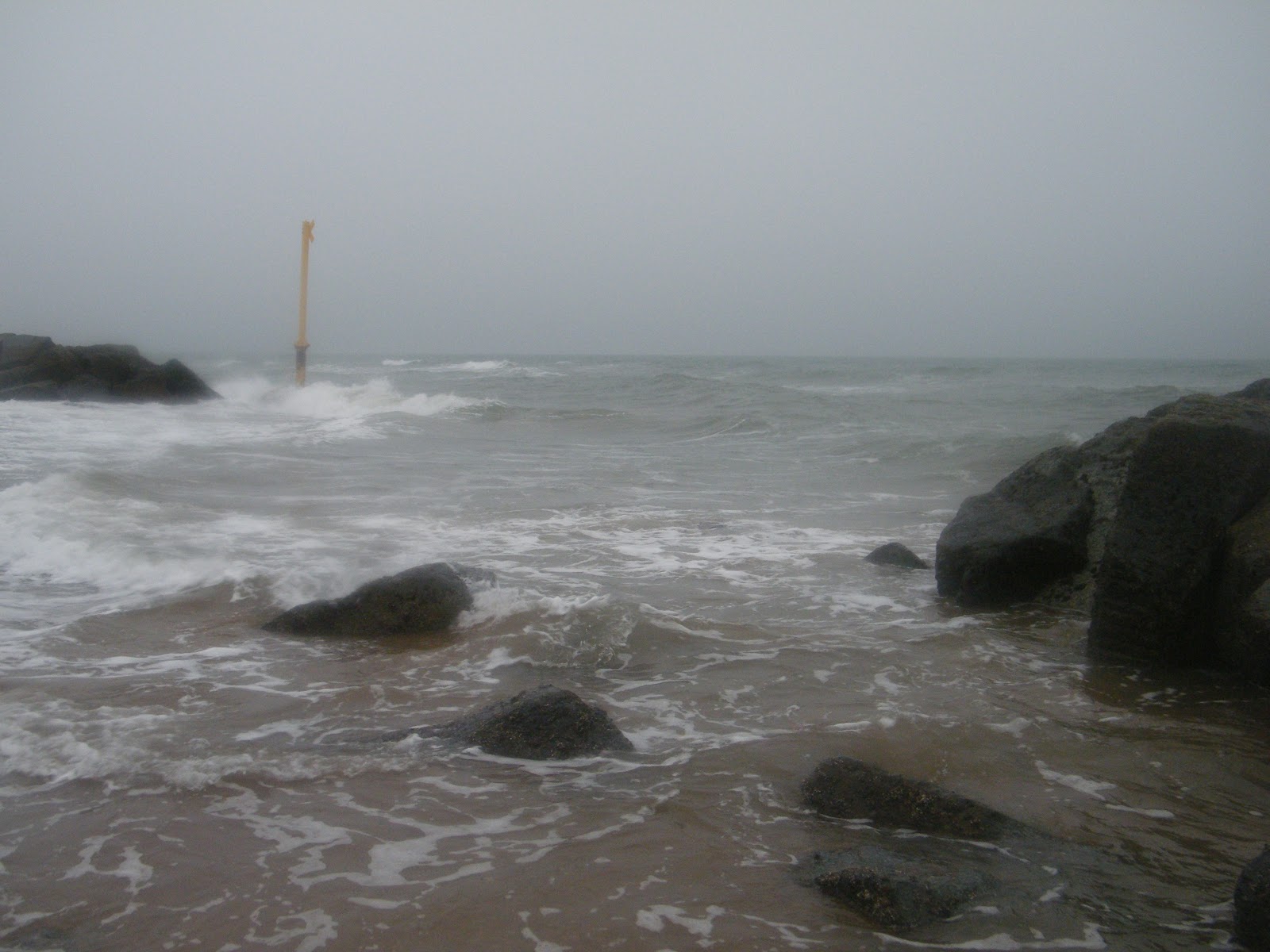
Since I never grew up around the ocean, it is still especially mystifying to me. I am still learning about tides, the ebbs and flows, the surging and sucking pull of the moon. Still learning to recognize the lapping patterns of waves on the sand, the coal-black yet shiny mica rippling up, the wind- and wave-tossed pebbles piling in ribbons stringing the shore. I watch the birds interact with the water, shaking feathers in the surf, watching dunlins and sanderlings scurry back and forth, out and in, mirroring the crash and flow of the waves. 


When the tide is high, the white crests riding and the sun is burning out silver patches into the horizon, there is a certain ominousness there, out on the bay. Not frightening, but there is something immensely grand about it, that leaves a lingering reminder that this is something too vast, too physically and metaphorically deep to grasp or understand. The sea becomes something cerebral, and I mean that literally -- it seems as if it is a vast mind, a brain, in its opacity. Speculating about the expanse and its nature is much like attempting to think about your own consciousness; I feel the same nausea sometimes, with it, a true sea-sickness, similar to that I get when I ponder the whys and wherefores of the universe, or the intangible aspects of the process of death. 


We like to think the sea is predictable, too, mapping and measuring the tides, for example, and publishing tables, etc, sending out submarines to survey its topology, model the trenches and abysses, the underwater mountain ranges and depressions, and the depth of the water that fills and covers them.


 But there is only generality, there only ever can be. We might think we know where the waves will reach, what the water will do -- but every wave itself is utterly unpredictable, a constant singularity forming and reforming in the midst of infinite pluralities, that never-the-same ever-the-sameness. And it is like a mind, every wave like a flicker of consciousness, flowing, breaking, reconnecting. 


When I was very young, I think I was under the strong impression that water was alive. Why else would we talk about 'running water'? Water in lakes, I supposed, was just resting for a while. Sleeping, perhaps. When I learned about languages that classified rivers as animate and lakes as inanimate nouns, I remembered my early belief, and realized I still hold something of that conception. I think of how I interact with ocean, when I am there wandering along the very edge, and the waves are frothing in, long rippling arcs of foam spreading over the smoothing of the sand -- I think of the unexpected waves that seem to reach farther in, reaching out to touch my feet, grasp at me, at the little twig-legs of the frantic sandpipers, the small wavelets rushing in to meet me, it seems, as I pass by. 


And it is this moment of contact, between myself and this great ocean, this unknowable mass, that makes me think of Solaris. 


2. So when I talk about Solaris, I am mostly thinking about the book by Stanislaw Lem, and its planet that is a lifeform, alive and sentient, covered with an ocean that seems to be breathing, acting, reacting, thinking. Like the ocean that seems to surge close to me as I walk along, washing my boots in the waves, Solaris sends out 'mimoids' and other strange shapes and forms, in attempt to communicate with the scientists who are poking and prodding it with x-rays and all manner of instrument, trying to understand something utterly non-human and thoroughly unintelligible.


And when I talk about Solaris, I am of course also thinking about the film by Tarkovsky (not Soderbergh! Don't even pay attention to that!), even though Lem wasn't completely pleased by that attempt at interpreting his work, and parts of it I feel are horribly melodramatic -- but nevertheless, this fan-made film trailer for Tarkovsky's Solaris is actually quite beautiful and gives decent sense of what we are dealing with, here.


So -- Kris Kelvin, a psychologist, travels to a space station orbiting the planet Solaris to investigate some troubling reports that recently came to light, as scientists studying the planet -- a sentient being -- seem to have caused some great disturbances in their attempts to communicate. 


Like the uncertainty principle of quantum physics, in which studying subatomic particles essentially affects the subatomic particles themselves, communicating with Solaris affects the planet itself. (How do you separate the observer from the observed? I don't think you can, especially not here.)


And then as Kelvin starts to settle onto the station, puzzled by the other scientists' allusions to the 'constructs' and the 'visitors', he is visited by his wife, Hari, who died ten years previously. She committed suicide after he left here. And now here she is, not quite aware of who or what she is, either. No one really knows. 


3. Not long after my Dad passed away at the end of last August, I had a number of different dreams, in which he appeared in different forms. Most of them were not traumatic dreams, though some of them did involve repeated dyings. The most disturbing of all, however, was one in which I saw a person identical to my father walking through a great wave of people. 


The crowd thinned as we approached each other, and I opened my mouth to speak, smile, but when I looked at him, he didn't see me. He couldn't see me at all, perhaps he couldn't see anyone. This image of my Dad, exactly as he had been, grey sweatsuit and feathery hair, just as he was the day he left home for the hospital for the last time, floated past without acknowledging my presence. He just kept walking, eyes unseeing of me. I tried to reach out, and received nothing. The residue of this dream ached for days. 


The dead returning to us in their human form is of course a common and terrible wish -- something perhaps we yearn for even as it terrifies us, because we know it will never, ever suffice, it can only distort. And perhaps we know that even if possible, there would be no great revelation, maybe not even recognition; Hari certainly can't provide anything for Kris. 


"I hoped for nothing. And yet I lived in expectation. Since she had gone, that was all that remained" (Lem, in Solaris, p. 204, trans. by Kilmartin and Cox).


For me, it was as if this dream was illuminating a great rift, the space between those living and those passed on in our daily lives, that there something so unknowable and incomprehensible, things we just cannot grasp with our mind's little hands, even if we try to make them as fluid and flexible as the surface of Solaris.


4. There is a lot I could say about Solaris. There are even quite obvious parallels to doing anthropology and fieldwork that I suppose I will write about sometime. But right now my thoughts are about the self, and connection, and communication, and how we aspire to understand ourselves through the Other.


In a key scene, which you should watch here, Dr. Snaut has Kris Kelvin read from Don Quixote. A little later on, Snaut denounces science (and its professed aims of exploration and understanding of other life forms) as useless here.


"We have no interest in conquering any cosmos" he proclaims. "We want to extend the earth to the borders of the cosmos. We don't know what to do with other worlds. We don't need other worlds. We need a mirror. We struggle for contact, but we'll never find it [...] Man needs man".


As Lem apparently once said about his Solaris ocean, 'I only wanted to create a vision of a human encounter with something that certainly exists, in a mighty manner perhaps, but cannot be reduced to human concepts, ideas or images'. And so here, they are trying so hard to communicate with Solaris, and Solaris is attempting to reply, sending them these visions, these simulacra, more mysterious unknowable forms -- it is indeed acting like a mirror, sending people manifestations of memories they try to control, forcing them to face people and circumstances they might prefer to keep hidden, that they strive to suppress. These are the words it uses to communicate, by showing the characters parts, elements of memory, that are of themselves. 


Solaris is not only about the limits of our abilities to understand things that are alien, non-anthropomorphic, that are not-us, that are so wholly Other -- but that we are never really looking for the Other. In the other, we only want to understand ourselves, our own lives as humans, both on a collective and individual level. And we always look to others. We move into that between-ness -- as Levinas noted, 'between-ness functions as the fundamental category of being' -- and we seek ourselves.


The simulacra are not of Solaris, they reveal nothing of Solaris except that perhaps it, too, is trying to understand itself through its encounter with the humans. By isolating memories that are painful, strong, and evoke emotion, is it trying to illuminate its own nature? Or is that supposedly foreign ocean just a repository of all our memories, the things we cannot understand, the truly un-fathomable?


Like death, like the ocean, Solaris is the ultimate Other. It attempts to 'offer that world to another' (Levinas) through its alien speech, attempting to communicate through these strange resurrections,invocations of the humans' memories that they, unconsciously, have offered to the planet. 


So many summations of Solaris, both book and film, always state that it's all about something like the 'inadequacy of communication between humans and non-humans', but I think it goes further than that. The futility of communication between humans and Solaris is telling, yes, but it is just another simulacrum, that pair, for human-human attempts. We can never really understand another mind, human or non, perhaps. We will never know all of the ocean, ever, just as we will never know all of another human's mind, no matter how close. But we will always try, and we need to do this. It's the only reason we exist. 


all photos taken in late February, early March 2012, Aberdeen City Beach.


*


Saturday, May 05, 2012

nesting

Nest amongst willow and kalyna, lower Riverlot, late October 2011


Last autumn, when the leaves fell, I began to collect nests. Amongst the bare bones of the birches and aspens, and nestled in the elbows of the high-bush cranberry bushes at Riverlot, abandoned homes became visible and I documented them all.


 Fallen nest, upper Riverlot, December 2011


Some had fallen onto the snow in the windstorms, small dried slivers of grass in the hatchings unraveling, revealing how the spaces had been insulated with moss and tufts of fuzz. 


Wind-fallen nest (same as above), upper Riverlot, December 2011

It looks tragic, but not all birds ever return to their old nests; some, who lay two batches of nestlings each summer even build separate creches for each group. Most grown birds (those that do not build inside holes) do not shelter or sleep in them, either. They are just small refuges for the flightless young ones, until their wings are strong enough.


Magpie's nest, upper Riverlot, early October 2011

All the magpies here have been busy for  the last month, scurrying around selecting twigs for their new hutches, which take weeks to construct and often involve multiple stories. But they too will use these homes only once; they may nest again nearby, however, and dismantle their old nests, selecting the best bits for prized parts in their new nooks.


Magpies made a hoop-like nook at upper Riverlot, early October 2011

If a nest remains un-recycled, sometimes other species of birds who don't seem to fancy the construction process will select one that has remained intact, often for a season or two, proving its safety and durability.


(Thinking of these nests, I think of my own life over the past three years, never living anywhere for more than a year, and generally less than. 9 months in Scotland, 3 in Alberta, 10 months in Yakutia, 6 in Alberta, another 4 in Scotland, with so many flights back and forth in between. I am more than migratory...)


Another cranberry nest, upper Riverlot, early October 2011

No one is really sure why birds tend to not return, even those that stay the winters, preferring instead to reconstruct and deconstruct, an endless process of nesting and re-nesting. Even the passerines, the perching birds, are not still for long. Most of their lives are movement, settling and sleeping are just small blinks, flutters of the eye in the path of a long flight.

(Dipper's?) nest in the rockledges at Grotto Canyon, near Canmore, early January 2012

I like to think that perhaps they are just better at cultivating and making peace with impermanence, mindfully hastening the change. Each carefully placed twig and tuft is like the pouring of sand into a mandala that is never meant to last; whether it is the wind or hand or claw that sweeps it away, shakes out their wings, and flies on.

Wednesday, April 18, 2012

adrienne rich.

                              
Adrienne Rich. (Source: The Poetry Foundation)

Adrienne Rich, source of this blog's title inspiration, and a poetic influence of mine, passed away a few weeks ago (March 27, 2012). Since then, I've been thinking about her often, at first only as she was a favourite author, but then because I was recently confronted with news about her support for a trans-exclusionary radical feminist.

I haven't always found myself in agreement with her ideologically, especially when her conceptions of feminism and sexuality got a bit too essentialist for me. And perhaps I should have suspected that she might well  follow that essentialism a little too far off the path into a pool of bigotry, but I was still shocked when I discovered that she--someone who confronted the overlap between sexism, classism, and racism and thus seemed to support an early intersectionalist incarnation of feminism--could support transphobic radical feminists.

The incriminating quote that is circulating the internet can be read about here; in short, Rich seems to have been quite profoundly involved the process of Janice Raymond's book 'The Transsexual Empire'. I've not read anything by Raymond, but if you scroll down in that Wiki article you'll see some pretty sickening quotes in that book. Her book, as I've learned, has had a lot of destructive impact on the way trans* women are treated in the world, its arguments used as a basis to justify countless theories as well as directly exclusionary policies that seriously diminished the well-being (physically, mentally and emotionally) of many trans* individuals. And this is simply unacceptable to me. 

I can't seem to find any evidence that Rich ever spoke about her involvement with Raymond's book. It baffles me, in some ways, because she showed in other cases that she was  never revisited these associations she had with the woman who wrote that book; she was definitely in a position to speak out and clarify her involvement, and for someone who stressed accountability and responsibility in all her writing, this upsets me. As Rafe Posey put it in this piece, "I can’t just think, “Oh, well, she was a poet, and she changed poetry, so her views on trans women are private and don’t matter.” That would be dangerous, and it would also be untrue".

 I too am disturbed that I am only discovering this now, that it is only being talked about now, because that is a reflection of the erasure of trans* women's voices, and also an indication of Rich's scholars and more dedicated readers that they thought they could just ignore this aspect of Rich's impact and not confront it, question it, or critique it. There is this implication that it 'doesn't matter' that she supported such abhorrent beliefs, because she did other supportive, proactive things. I can't do it. I can't let that slip.

Someone said to me I was being ridiculous, judgmental, even, that I couldn't just appreciate the creation without the creator.. But I can't overlook these things. I believe we are whole people, and we are accountable for all of our actions; we can't separate, bifurcate ourselves. I also believe we have a deep connection to what we create, and what we say, what we express.  Doing or saying some good things does not let the bad things slip quietly away out the back door untouched and unchallenged; we need to all personally confront those things. And she didn't do that. She was silent. And as Audre Lorde wrote, 'your silence will not protect you'. Adrienne Rich reinforced for me that poetry is a political act, and it is especially for this reason I am so disappointed in her. 

I can't repeat enough what the post on You're Welcome states: We can begin by acknowledging that it matters. All the things people say and do matter. Yes, of course we are all flawed, but what does that mean? To me, it just reminds me that we all need to confront all the messy hatred and stubborn beliefs in ourselves. 
For a woman who wrote that we must 'read and write as if our lives depended on it', it saddens me that she didn't seem to realize by her writing she was further condemning the lives of others. Where was the responsibility, the lucidity she swore herself to, in all of this?


***

I am curious to know, if anyone is reading this, how others reconcile these kinds of complexities in what people make, and the beliefs and statements they might otherwise express. I just feel sad and nauseous when I think about her now; she wrote some beautiful, powerful things, but I can't look at them in the same light any longer. This has happened before, with figures and creators that I have admired to a lesser extent, but I guess, in mourning her, I am also mourning the loss of the role of her poetry in my life. 


Saturday, April 07, 2012

tennessee williams, on poetry

sign on broad hill, aberdeen, february 2012 -- part of an primary school art project challenging all the prohibitive signs in the neighbourhood. they are all very poetic in their own way.

Tennesee Williams is not really my friend at all (bit of a misogynist, that one) but I came across a quote of his recently that resonated with me, especially as I am in the midst of writing my dissertation, the process of writing an ethnography, and I am determined to produce academic writing that is inspired and creative, something full of image and life, something poetic. So this is a good reminder, because no matter what genre I am writing, I think I am a poet at my core. That is what I write, what I create.

I'm a poet. And then I put the poetry in the drama. I put it in short stories, and I put it in the plays. Poetry's poetry. It doesn't have to be called a poem, you know.
TENNESSEE WILLIAMS, The Paris Review, fall 1981

Sunday, March 18, 2012

haunting, part 3/3

reflection on upper grassi lake, canmore, january 2012

***

Haunting, 1/3

Haunting, 2/3


I suppose it’s the very nature of death itself that confounds me, unknowable to anyone, perhaps even as it is happening to you (and then perhaps its very nature, its essence is rendered utterly irrelevant, at the only moment it would be possible to know). And it’s really silly, because again – how can you ever really know how it feels for anyone else? Ever, about anything at all? Perhaps it hurts because it is the incomprehensibility of death mirrors the true understanding of anyone other than yourself (and even then, it can be tenuous).

A few weeks ago I sat through a seminar about Emmanuelis Levinas and how the lecturer wanted to use him in creating their new vision of anthropology; it didn’t sit well with anyone (do not tell social anthropologists that objectivity exists, e.g.) but I was happy that it reminded me about Levinas who I hadn’t really thought about in years.

Levinas wrote of our solitude of Being, and about the Other. How we can only know through the Other (in that they are a sort of mirror), the Other can never be completely known. We do the best we can to comprehend other beings; like yet like Simone Weil (another philosopher-friend of my soul) noted, every separation is a link. We come into Being and until we die (de-create) we try to reach out through that space between to understand. We do this through language, through speech, as Levinas wrote it “brings the world to the other, thereby creating a common world”. Speech is “the offering of a world to another”. I wrote in my journal last fall, in scribblings for a poem, that ‘death reveals the failures of language’; and it was such a comfort to see this feeling reflected in his words.

Our deaths are not really ours, thinks Levinas, but our consciousness comes from how we are haunted by the other’s death. And death—death makes you feel so helpless, it seems to me, because it others the Other; that is, in destroying the Other it destroys all hope of understanding. You no longer have a mirror to help you understand yourself; you no longer have your conversational partner with which to gift the world and receive a certain comprehension.

But we have to live with this, these hauntings, and by expressing, acknowledging them, I think we can free ourselves, if only partially, from these places where language, where everything we rely on to make sense of the world breaks down.

haunting, part 2/3

willows on water, upper grassi lake, canmore, january 2012

***

Haunting, 1/3

And I am haunted. I don’t know how to express this, sometimes. How it still stops me in the middle of the day, and I am overcome by it, how it catches up to me just before sleep and I cannot because of thinking of him.

Mostly I am just struck again and again by the last day I spent with him, how we did not expect that it would happen so suddenly; it is the knowledge—and that I must ultimately accept that knowledge—that I will never have any idea what he was thinking or feeling when he did pass. Or if he even knew he was passing; a ‘massive cardiac event’, they called it, occurs so quickly you are often dead before you could even become cognizant anything is happening to you.

It’s not about being there when it happened; unlike my mother, I am okay with the fact I did not witness his death because I do know he would have wanted it that way. He was very private in his suffering; my mother and I (and one day, my sister) were the only ones he would allow to come see him in the hospital. He would not want others to be there to see him go.

***

In my notebook I wrote a few weeks after my dad passed (Sept 15 2011):

It scares me when I can’t quite remember those individual last days, the little details of the time I spent in the hospital with him. All I can distinctly feel is the ache of it, of seeing him too fatigued to even speak much, of his confusion, and the helplessness of knowing there was so little I could do. Bring him another blanket, take the water glass and tilt the straw up to his lips, adjust the oxygen tubes, remove his glasses and carefully fold him onto the nightstand before he fell asleep again.

I try to remind myself my being there helped him; I would think of how indignant I was initially when I came home from Scotland the first time and he didn’t have much to say to me, but feeling better when Mama told me that it just made him happy I was there, he just appreciated my presence there, with him, being silent together. I know it helped him, but that too makes me ache. How he would call me to help him walk up the stairs when he was still at home; then, the afternoon before he was taken by ambulance, to just sit in his room with him, because he felt so anxious, his breath was short, and he was afraid.

I am trying to construct a narrative of his last day. Of talking to him that morning; he was sitting up, sort of staring at the newspaper when I came in. How he asked me if Jack Layton had died, and I said, yes, he had. “That was fast,” he whispered, eyes widening. I told him I was going to postpone going back to Scotland right away, to stay home for a bit and help him when he got out of the hospital. How he got alarmed, and annoyed with me, told me to go hurry up and finish my PhD, but then softened and told me how much he appreciated me offering to stay. He slept a little while, and I did the millionth crossword puzzle I’d done that week.

Mama came, we found out it was not amyloidosis causing Dad's present state. Good news, yes. I left, went to meet Jason after work and cried on the sofa in SUB because despite the supposed good news I was realizing something I couldn't even begin to articulate. Went back to the hospital, to see him while he had his dinner—I cut the chicken parmigiana into tiny little morsels and fed them to him, his last meal. My heart was breaking at this, into tiny pieces at the full circle I felt had been turning since he got sick, the slow turning that I was already parenting my parents. But I made jokes about airplanes. I promised I would come early and be there to feed him his lunch the next day.

And Mama and I came, and we rubbed cold, swollen feet together, covered them in more warm blankets. I kissed his mountain-man whiskers, told him I loved him. He said it again to me, thanked me as I walked out the door. He waved to me, a slow opening and closing of his palm, the way he always did lately, too tired to move any more.

I need to remember these things. I need to because it just pains me so much that I will never know how it was when he died. I woke up the next morning to Uncle Ron throwing pine cones at Jason’s window and I was struggling to understand why I heard his voice and put clothes on and see him standing there with Mama telling me that Dad had passed away.

And it pains me so much that I will never know. I want to know, I have this need to know because if there is anything that ever comforts me it usually involves knowing. But I will never know his last moments, whether he was even conscious, if there was any struggle or raging, of if it was just a sleeping exhale, a ceasing unaware.

And what he told Mama after I left, about the brightest light he’d ever seen, earlier that morning while sitting in his chair before I came, there with the curtains drawn and through the window the most striking whiteness. Was that extra love and goodbye he sent to me as I left the room his way of telling me he knew? Did he know it was coming? Did he understand that light as a premonition? (Mama told him he was dizzy, needed to eat more)

I just want to know if he knew, and I know I won’t, I can’t. These narratives we construct are just ways to try to convince ourselves, comfort ourselves. I know death has little to do with the one dying, really.

When it all comes down to it, I am relieved, relieved I could be there, could say what I needed to say. Deeply honoured that I was close enough to him for him to allow me, ask me to care for him in those last days. I cannot convey, as much as I try, how much this means to me. To be there felt sacred. He gave me life, and he gave me so much in my life that has made me. I wish I could have given so much more, but I am thankful I could give this much. It was all that could be given. I know this.

But still, I just cannot bear the thought of him hurting, that he may have suffered in the dying, because I know he was suffering before. I can’t stand that. Can’t handle that. Cannot. Haunted by that.

haunting, part 1/3

birchbark, layered and peeling, north sask. river valley, edmonton, end of november 2011

***

From Barthes ‘Mourning Diary’: “Mourning: not diminished, not subject to erosion, to time. Chaotic, erratic: moments (of distress, of love of life) as fresh now as on the first day…” – Nov. 29th.

It’s been six and a half months since my father passed away, and I still haven’t written a letter to his main treatment physician to tell him that I think he is an incompetent asshole and that his treatment (or lack thereof) of his patients makes him a terrible human being.

But I am working on it; there is just a lot to still truly comprehend, in its most literal sense, to grasp, seize, take into the mind. There will likely be many letters to write; numerous versions exist already in my journals, my head, but many of them are too slanderous to send out into the world. It might be nearly seven months along but in many ways I am still not coherent enough to express some of my anger and anguish with regard to how things happened. They are particularly potent because they go beyond this one separate incident and speak to the ways illness is viewed in our society, western medicine’s mechanicalization of the body and its functions, and health care as a business (even if it’s not privatized, yet!) They speak to a lack of compassion that I frankly find terrifying. And so some of these things are yet to find their expression in words; I can’t yet do justice to what I want to say about them.

Time is not the healer of wounds. All time does is allow you to figure out how you are going to live with things, to let you accept and incorporate yourself into a new reality. At this point I feel less like I am living in an alternate universe, yes, time has helped with that. But that doesn’t mean I still don’t feel pain at his death just as acutely as after it happened.

Barthes: It is said (…) that Time soothes mourning. No, Time makes nothing happen; it merely makes the emotivity of mourning pass”. --March 20th.

I still hurt from my grandmother’s death over 6 years ago. I will always miss her fiercely. However, I feel less pain from her passing. It’s not because of distance in our relationship; we were incredibly close; but I was able to understand and accept her death much more swiftly and easily. She was nearly 91 years old; just over a month before she passed away (before she was hospitalized for a haemorrhage deep inside her brain) she stated to us that she wasn’t going to live another winter. She commented that this cheered her, because she was missing her mother (who died nearly 50 years prior) and she looked forward to seeing her again. She was tired, she was done. And there was grace in that. But my father wasn’t near finished. And I ache not only for the fact I don’t have him around anymore—

(though I constantly remind myself I am lucky, his own father died when he was 21, my mother’s father when she was just 10)

but because there was so much more he wanted in life. Yes, he was 63, but he was not ready to be finished with this just yet. And that will always break my heart.

I don’t believe loss, and mourning a loss, is something to ‘get over’. It is something that has changed you. Like having cancer, it is something you do not fight to be free of, it’s something you must simply learn to live with.

& I get frustrated sometimes by the subtle disbelief and frustration people show if I mention I am still grieving. I don’t even know if they realize they do it, but I can feel it sometimes flickering in, a swift dismissal, a lack of engagement. I try to be understanding, knowing that losing a parent (regardless of your relationship with them in life) is not something that’s easy to imagine outside of experience. But I think because people who are not well acquainted with grief and mourning are also terrified of it, and therefore they would like the bereaved to hurry up and go through it, you know – gnash and wail for a bit but get on with it. They don’t want to know that it haunts.

Thursday, March 01, 2012

dear yakutsk

Dear Yakutsk, I miss you. I didn't think I'd be having these feelings a year later from when I was still wandering your slippery February streets, waiting for them to melt into the morass of mud as the earth heaved into spring. But I do. I think about you a lot these days, when I'm writing my dissertation, and since I am basically always writing/thinking about my dissertation these days, you are never far from my thoughts.

(The ice cream stands and those pomegranate-champagne popsicles and how children eat ice cream on the street even at -40C. Strolling with friends through the Park Kultury looking for first crocuses, glimpsing the berry-red breasts of bulfinches, sitting on benches the first jacketless day basking in wind and sun)

You--as a city, a centre, a place people move through--are becoming pretty important as a concept in my writing, because of what people consider you to be and what you do to their language, or perhaps more accurately, what their language does to you. Because place is never a background, no mere scenery -- place is an actor, an interlocutor, it is something more.

(Tea with Fenya at that little café named after Mister Livingston Seagull for no apparently reason, weeping until our heads ached after seeing the play 'Taptal', eating cabbage pirozhky, nimbly walking through the flooded streets, around the riverine roads and their ice floes, time to gulyat', to ramble and wander, nowhere in particular but eventually home)

I am talking about mobility, and movement, about people moving and being in places and referring to places, and speaking in places and from places, about things taking place. And Yakutsk, you are important. You are a mecca and a temptation, a place of possibility and a necessary evil. You are a strange collection of pebbles along the banks of a very large and powerful river, ruins and transformation, and people hate you and people tolerate you and they also love you, both purely and begrudgingly, because you are home for so many, at least temporarily, and it is people that make you, really, and it is those people who (grew up within you, came to you later, wandered back and forth) who hold you together.

(Out at Liuda's dacha on the city's edge, we rake the leaves and the long grasses, like combing the unkempt hair of the earth, tidying, readying for the spring. Call of the wagtail, flickering against the blue, blue sky. The quietest nights in the pine-scented cabin darkness, waking to the match strikes and kettle whistles. Furnishing the summer kitchen, burning herbs and making an offering to the fire--the hotplate--to consecrate this space.)

These aren't even my best pictures of you, but I like the ones I posted above, of people dancing the ohuokhai on Victory Day last May, dancing on you, because there is still earth beneath your concrete cobblestones on the Ploshchad Pobedy, and they remember that.

(Spring nights, the windows open, curtain breezes. Tea and transcription. In the courtyard, the sun lounging on the horizon, steady thump of basketballs, beat to the guitars and Sakha pop songs strummed. One day they are playing circle games, then someone starts to dance ohuokhai, these young students from the ulus, a girl is calling, they are answering and they go faster and faster over the uneven cobblestones until the vakhtërshka calls them in)

You are hazy, in the ice fog and the early summer forest fires, and sometimes you feel stagnant even though you are still growing, spilling, sprawling. Sometimes you feel like a real city, but what is that anyway, but yes, not just an aggregation of buildings and paths and things, you are a whole and a system and you work. Shakily sometimes, without water sometimes, but you function.

(The thickness of the cold as the wooden doors creak out into the bluish daylight. Every breath a blessing. Strange to see the foreign fruits and vegetables in this wasteland, chat with the bewildered Uzbek boy who never knew you could survive in this before. Frozen fish sold on the streets, in brown wooden bins standing solidly like thick iced baguettes. Cars materializing in the fog, the scurrying masses, mittened hands over their faces. Quiet except for the fuzzy footsteps, the crisp whisper of stars in your breath.)

I wish you had more trees, of course, but I understand the whole river steppe-plain thing and really short growing season. Your birches are lovely whether losing their gold early or weighted by hoarfrost, branches tired arteries, or growing their first green leaves, the ones people compare to the tongues of carp.

(The wooden houses, still standing weathered after another winter. Ice cascading over the leaky waterpump. Flocking of waxwings in Zalog, lining the telephone wires, swooping to devour the ashberries, swirling up into the sun. Shashlik on the street corner, and everyone emerging from their small stacked apartment nests to skate out March and April on the oxbows, make long lazy loops of the Green Meadow on skis after work as the sun finally starts to linger into the evenings.)

Silly foreigners will say you are not a real city, that your architecture is a shabby and cheap pastiche, your restaurants are naive and pretentious places aping the cuisine of a 'real' European city and yes, there's a lot of trash everywhere and half-wild dogs (who have their own parallel civilization), the sidewalks don't know how to lie flat on the stretching, thawing earth--but you know better than to listen to them, because it's not even worth having debates about taste. Your own citizens will complain about you, apologize on your behalf but they'll also defend you, they'll stand for you, because you stand for something, for them.

(Peeling pastel pink paint, the bright jewel-toned murals, the infinite repetition of the lyre-like folk designs--fertility, new life, fortune, light. Someone gives a blessing as earth is turned for the new hospital. Dancers pour out of the theatre into the square. Flowers for Ammosov, day of the Republic. On the weekends subbotniki gathering the trash out of the sloughs and marshes, stopping to picnic by the spindly birches. At the long-distance bus depot, men chat, joke, smoke silently, resting before they head off again, lifting up their faces to early summer sun.)

You are a place where things happen. Where people live and makes things, and they are making a lot of things and they are making them in the Sakha language and the Russian language and even the English language and they are trying to rise above corruption and loss and uncertainty and that is really something. They are trying to inspire and allow themselves to be inspired. That is what happens in places. That's really enough for me.

(Also, your sunsets and clouds and skies in the summer from my kitchen window crossed by swallows are some of the most breathtaking I have ever seen, and I've been to Hawai'i, and you win.)

Sunday, February 12, 2012

first snow (at the edge of the earth)


These were photos of the first snow at Riverlot, back in mid-November (and was probably some of the most snow we've seen this year at home, strangely enough). And that day I was thinking about my dad, and how since I'd been away he would always send me photos of the first snowfall. I always appreciated these little updates of what the earth was doing, faraway in my homeland.

He was never one for speaking much on the phone, so especially cherished these little notes of his, whether snapshots from the backyard or recent fishing trips or photos of especially cute Jack Russell Terriers or news snippets he'd come across that he thought I'd like to read. And opening my inbox now every morning I am constantly reminded of the absence of his emails, that I never see his name pop up amongst listserv notices and the daily flood of university tasks.

Perhaps even more strongly, I still feel a wave of grief every time there is something I want to tell him -- something interesting that I've read about fossils unearthed or deep sea fish newly discovered or antediluvian bacteria trapped in Antarctic core ice (shades of the X-Files!) or how the week after he died they found the feathers of dinosaurs trapped in amber in the southern coal fields, how they thought they'd finally captured evidence of particles moving faster than light. These are the things we'd marvel at together, and they remind me of his sense of wonder at the world; to not be able to tell him these things, share them with him, feels like waking up in the night and grasping around in the dark for something that can never be touched, isn't even there where you thought it was.

Last month I read Roland Barthes' 'Mourning Diary', a compilation of thoughts he jotted down on cards the year(s) after his mother passed away after a long illness. They devastate me and at once leave me with an immense calm as I find so much of what I experience mirrored there, raw and unapologetic, in this instance, the realization that there is so much I am never going to be able to tell him, talk to him about:

Feb 12th. Snow, a real snowstorm in Paris; strange. I tell myself and suffer for it: she will never again be here to see it, or for me to describe it for her.

I used to eagerly upload my fieldwork photos, and those from when I was first in Scotland, to show him these places where I was too, these places he would never see other than through me. To show him these things also comforted me, and sending him these things became a way of reminding myself, reassuring myself that this is what he wanted me to be doing; that I should not feel any guilt whatsoever at being away from him while he was ill. I wanted to create and discover beautiful things, and share them with him, as a way of showing him what his support for me could do. And so we were conduits for these little quotidian experiences, bits of knowledge, and this always connected us.

So much of grieving, and the aftermath of a death, is about renegotiating your relationship with that person. They still exist, but in a different form now, in a way that makes your brain try to grow tendrils in order to try to reach and wrap itself around this change of state and tense.

In the weeks after his passing, though, I had a dream, the first dream with him in it after his death. He walked into the kitchen like nothing had happened, and I rushed over to him and I was crying in my sleep, holding on to him, telling him how much I missed him. He told me not to worry, he was doing fine, and I asked him, had he heard about the feathers in amber? And he said, no he hadn't, yet, but he was going to remember that, read about it later. Let me just grab a pen and write that down, he said, just like he always did when he asked me about something, so he wouldn't forget the details. And certainly, I know that I still can tell him things, tell him whatever I want -- but I have so much trouble handling the fact it still feels like a monologue. I don't know yet how he can respond.


Saturday, February 04, 2012

on these legs

Self-portrait in the fields at the edge of the earth, Nov 2011

This evening, I am so tired, and lately I feel constantly reminded that I have been under so much stress this year, that the fatigue still hasn’t quite seemed to lift. I feel irked, because sometimes my body does this, gets uselessly tired, but refuses to sleep at night and then begs for naps by mid-afternoon.

Such a strange body, sometimes. Often it’s my body’s inner workings that frustrate me – the heaving, knotted tangling of my guts when my digestive system malfunctions, the sudden, insidious stroke-like misfirings of my neurons that bring the pain, nausea and incoherence of migraines.

Other times it’s my appearance. The way I am too bony in places, too lumpy in others. A face too soft-featured, indelicate, and plain. Pale as a white whale, but with dry skin, freckle outbreaks, and incorrigible body hair.

Being annoyed with my body directly translates into a generally unpleasant emotional state, just as less-than-stellar emotions bring pain felt in all manner of ways. Anxiety that I feel nearly constantly sometimes pervades every part of me – during a nearly year-long period of intense anxiety when I was younger, I ate hardly anything, because I felt such tension and blockage in my throat and windpipe I worried I was constantly about to choke.

But what I am trying to express here is that I don’t want to feel negative about any aspect of myself—because there is no such thing as dualism despite what Descartes says, don’t listen to him—and I am always trying to reconcile the way I’d like to think about my self and this body that I don’t just dwell IN, but exist AS. This is the only form I know, and I am grateful that I am living.

While running the other day, I was feeling my leg muscles creaking and searing in the damp cold, and I remembered something my dad said to me this summer, one time while I waited for him to muster up the energy for me to help him walk upstairs. I was sitting on the floor, stretching a bit, and he observed, “You know, you sure have Ferguson legs, my legs”.

And I looked at them, the ones everyone in track called ‘turkey legs’, because they weren’t as skinny as the long-distance boys’ efficient chicken-legs, nor as long and shapely as those of the other girls. Thin little forelegs under massive thighs, with patchy hair and an uneven tan.

But now I focused not only on the taut curve of the quad and slimmer slope of the calf, but tried to really feel them as I stand up, each joint and sinew unfolding, blood rushing through the hidden webwork. They are so strong, and they carry me well. “Yes, they’re good ones”, I say to my dad, and I help him up to bed.

I think of his legs, then, swathed in his grey sweatpants that seemed to become more and more voluminous. In the hospital, I massaged his pale, swollen feet and calves that could never stay warm, the limp ghosts of legs that cycled and walked daily not so long before, that once led me high up into the mountains and later followed me along those same trails.

And when I was running, North Sea sand under my feet, straining in the wind, I felt something of my father in my legs, a current running from the depth of the muscle and springing into the earth. And there was pain and there was lightness, there was an energy that comes from the remembrance of power, and I felt I was honouring him.

I need to be good to myself, my body, and see every part as a gift, be grateful for it. All of the aches and discomfort within it, the strange outer aesthetics and my ambivalent feelings about them.

I have his skin, his colouring, and it is on his legs I run. I am physical pieces of my father left on earth.

Thursday, February 02, 2012

tops of birches

Kirsten Everberg: White Birch Grove, North (After Tarkovsky), 2008

White Birch Grove, North (After Tarkovsky), Kirsten Everberg, 1998.

***

Tops of Birches


as though
nothing changed:
oh
stillness--after
whispering
gazing
and hearing--


(and i forgetting it was life long forgetting the past voiced as a cradle song so as to remember the rest of life the lullaby with its silent-originary spirit primal opening of me a widening it promisingly freely without limit)


oh
stillness--(long time already there is no one):
the air--among the tops:
of birches


(1983)


more about Gennady Aygi (Chuvash poet, writing in Russian to survive) here
also, lovely essay by one of his first English translators

Monday, January 23, 2012

as love is, home is (erin mouré)

local foxtails in a local field, taken on solstice, dec. 2011

(Dear blog, I am sorry for neglecting you! Sometimes months go by. I still haven't finished my autumn chronology of photos, but soon...)

Mostly I just want to exclaim with great anticipation over Erin Mouré's new book, which is currently finding its way over the Atlantic to me; I vaguely knew it would be appearing, and that it dealt with her mother's childhood emigration from Western Ukraine, but I found her blog about the book the other day and it brought me such excitement I ordered the book immediately.

It's a little collection, this blog, of excerpts and related links, parts of the process of the book coming together, and already I cannot wait to immerse myself in her narrative(s). It's a book-length poem, her mother's story of 'coming from nowhere', from a place caught between the Ukrainian and Polish borders, complicated by wars and top-down struggles of exclusion/inclusion that didn't mirror the way her people felt. I am just so excited that it examines the idea of the 'local' -- tuteshnyj, in Ukrainian -- that is less about ethnicity and more about the belonging to a place, to a community of people (of beings, of entities) which is something that needs to be examined deeply and seriously, especially in this part of the world.

(if you read nothing else on the blog, read this bit -- this is the essence)

She alludes to the violence caused by ethnic and religious labels, of the various ruling powers' (Austro-Hungarian, Polish, Soviet, Ukrainian) need to categorise and create not only physical but mental, emotional borders between people, and how this was so utterly destructive. From a family considered 'half-Polish, half-Ukrainian', she discusses the trauma that this caused her grandparents, and the dismissal she even received recently about her 'ethnic heritage':

Although today’s independent Ukraine is still rife with confusions and the need for new historiography that fully admits all parts of its past (imagine here: the professor in L’viv who eagerly asked me my family name then responded flatly and without interest “that’s a Polish name,” effectively expelling me again from national territory that is just as much mine as it is hers), it does now include as its citizens everyone who lives on its territory. All, today, regardless of background, are Ukrainians. And I am half Ukrainian, of the Hamulyaks of the earth and of the Hrandyshi of the air, the tuteshni, the people “from here.” I come from people of the Ukrainian earth who trade with and recognize the legitimacy of all the peoples.

(Erin Mouré, Here.)

My own family's story is a little bit simpler, at first glance -- they lived much further away from the Polish border, in a town 'overseen' by Polish landlords but there did not seem to be such tensions between the two 'peoples'. I've heard other families from the area arguing about whether their names are 'Polish' or 'Ukrainian', but in my family it seemed less contentious -- my baba identified herself as Ukrainian, mentioning Hutsuls and Boikos (Ukrainian 'subgroups', according to ethnographers, and another issue in itself!) as what her people were often called locally ("but there were many Polish people, and Jewish people too" she said), and maybe it's because her own mother's family had Tatar ancestry and she married my grandpa who carried an old Czech name, but Ukrainian-ness itself was not something she mentioned much. The nationalist aspect didn't seem to interest her much.

(On my grandfather's side -- also from Nebyliw -- there was more tension, but in terms of religion, not so much ethnicity, with Eastern Orthodox and Jewish people being forced to 'convert' to marry Greek (Eastern) Catholics, causing some rifts when children of the 'converted' decided to take up the other faiths, etc. But I don't know the full story there, it's only becoming unearthed as of late*)

What struck me more was the way she referred to the place she was from. She didn't talk so much about 'Ukraine' -- after all, that wasn't so much what it was called when she lived there, other than for a few brief years when she was very young -- but of Nebyliw itself, her village, and of the Old Country.

In fact, one my earliest memories of this is from when I was about 4 and I was playing with my globe. My dad had been teaching me country names and I was just learning to read so I was trying to identify them. I searched and searched, but got quite frustrated and indignant when I couldn't find 'The Old Country' anywhere on the map. "But that's what she calls it!" I said to my father when he laughed at me.

This reference to the old and to the new made it seem to me that it was less important to her about being from 'Ukraine', the imagined community, but rather, it was this old country, from Nebyliw, that physical place, where there was a community of people who spoke at least three different languages and herded cows, and sheep, and planted crops and brought fish and eels to the nearby market in exchange for salt, and ran logs from the mountains down the Lymnytsya river.

And so I am eager to read the story of Mouré's mother, and the village of Hlibovychi Velkye, to better understand these border stories, the way her family experienced the local, the being from here, in a place that saw great turmoil and great tragedies. It heartens me that links to this site about a whole project aiming to research Ukraine from a non-nationalist point of view (rare in the post-Soviet regions, let me tell you!) and it gives me hope for new ways of analysing and understanding this place my own mother's multifaceted relatives came from, and understanding what I have inherited through my family's fraught history, and understanding what place meant to them.


*I also wish I had asked my own baba more about what happened in her village in WWII (it was a site of combat in WWI, when her own father died, and sometimes families were split by the border of fighting for Austria-Hungary vs. fighting for Russia), but they left shortly before things got really awful in Western Ukraine, and I wonder how much she really knew, what her relatives told her. I know some of her relatives helped hide some people from the Galician SS and from Stalinist purges at various times, but again, I don't know the whole story. (This is another reason that Everything is Illuminated destroyed me especially thoroughly, knowing that such things likely happened there too, in Nebyliw, to my relatives).