Monday, August 27, 2012

one year.

Sky breaking over the Wind Tower, Canmore, January 2012


"Mourning: not diminished, not subject to erosion, to time. 
Chaotic, erratic: moments (of distress, of love, of life) as fresh now as on the first day". 
Roland Barthes, Mourning Diary.

*

My dad passed away exactly one year ago today. It was unexpected, in that although he was in hospital and had been suffering from myeloma for at least six years, the day before we'd heard that whatever was affecting his heart and liver was not amyloidosis! More intravenous chemo! they said. He'd be an outpatient again soon. And I'd see him again the next morning, that he wasn't waving goodbye to me for the last time. That I would speak to him again the next day, and he would answer me.  Instead, I would be woken early to go stand over him after he was  already gone, his head turned to the door, eyes partly open, and begin the long one-sided conversation of grieving. 

That is the most difficult part. To never have an answer in words, in the only language you've ever used with him now utterly insufficient, completely useless. To want to share so deeply with him everything I am experiencing, and feel my heart burst every single time it happens and I remember it's not possible. It's happened so many times over the past year -- I live, feel joy and awe with the world, discover something, and want so deeply to tell him, because that is what he did with me. He shared so much of what he loved with me, and I can't even begin to explain this inheritance and how it has shaped me. If it was my mother who has taught me to love words and things you can do with them, it's my dad who helped me to really approach the world, to experience it profoundly and make me want to use those words for something. Ironic for someone who was never much for poetry, yes, but it's his, that quiet, ever-open eye and mind he helped to train in me, that I use when I capture the light, when I write.

There is such gratitude, thankfulness today, for him, because I am lucky to have him as a father, to have had him in my life. But there is still grief. There always will be. Such things can co-exist, even in the pain the grieving brings. I just wish that the society I live in could better openly acknowledge grief, and recognize that it is not just something to 'get over', that whatever way it works (in spirals, a tidal movement) it is anything but linear. There is no wound to heal over with the supposedly magical powers of time -- rather it is one that simply changes shape and form, but always remains susceptible to itching, re-opening, flarings, bleeding and acute, intense pain at any stage. Like, as one friend astutely noted, the fragments of glass embedded in skin after a car crash, that work their way up through the dermal layers for years, precipitating on the surface. Or the nematocysts injected into the body after a jellyfish sting (as I well know) that can become inflamed long after the initial encounter as they wriggle up out of the flesh. It never really gets better, only different. 

The last few weeks I've been travelling, and a few days ago I started to cry at the remains of the Berlin Wall because I felt, once again, that this is how it will always be, for the rest of my life -- that I will always be experiencing things and wishing he could be there to share them, or at least for me to tell him about them, show him my photos that he always loved, Maybe I will come to feel that he is part of me, living through me in the way I feel my baba is absorbed into me, that she is within me. But right now the fact is I don't feel that, and that he just feels slightly out of reach, and I am straining, straining to reach out to him, without words, with such inexpressible futility. I simply miss him so acutely it makes me physically ill at times. And it is this loss of discourse in these human terms, the only ones I know, that hurts so much. I can talk to him, yes, but oh, death and its lack of  responses, answers... 

So I just remind myself that I am allowed to miss him, allowed to hurt, allowed to grieve, and most of all, allowed to express it. We may not be able to have dialogues (in our usual language-based human terms) with the dead, but if I had my way, we'd be living in a society that was a lot more comfortable having dialogues about grief and mourning and everything that will always be part of our experiences with death long after it happens to those we love.


Sunday, July 29, 2012

sixty-four

 Birthday dinner for my father by the mouth of the Don, Aberdeen, July 23, 2012
 Birthday offering and the quiet river mouth before sunset, July 23rd, 2012
 Sunset over the Don near the estuary, July 23, 2012

Water on the shore and the luminous sky, Aberdeen city beach, July 23, 2012

***
This past Monday was a difficult day; July 23rd would have been my dad’s 64th birthday. A few days previous, when talking with my mama, the Beatles’ song, When I’m 64, got annoyingly and depressingly lodged in my head, but I didn’t mention it to her, lest she suffer the same fate, and also because it would hurt her even more, for what would she not give to still have him there, growing old with her? 

My dad wasn’t the sort of person to get too caught up in birthdays. Unlike my mother, who likes to have her birthday dinner and presents on the actual anniversary of her birth, who takes great care in that sort of festive commemoration, my dad didn’t seem to mind if you gave him gifts on the day, or when the celebrations happened, or even if you weren’t there that day. He was quiet and laid-back, and being the centre of attention never appealed to him, so grand gestures were politely refused and festivities beyond a quiet dinner (usually involving barbecued things, pizza, chocolate desserts finished with a little rum or whisky) never really occurred.

I think my mama always had trouble accepting his lack of desire to mark the occasion. Rather mischievously, she poked fun at his reticence to observe this occasion. She never did anything like take out an ad in the newspaper proclaiming ‘Lordy lordy look who’s forty’ or have fifty vulture-statues skulking all over the front lawn. However, on July 23rd, 1988 forty black balloons adorned the garage door. (They popped in the heat of the early morning, causing him great alarm). In 1998, fifty colourful cut-out paper fish (courtesy of her grade three students) appeared dangling from tree branches on our front lawn. He took these all in stride, and I think he was secretly amused by her sneakiness. Nothing happened in 2008, but the next year when we were in Hawai’i for my sister’s wedding, we had dinner at a restaurant with an aquarium. If it was your birthday, a diver would swim into the massive tank to feed the fish while you were eating, and hold up a birthday sign adorned with lettuce and seaweed; all the manta rays and wrasses and triggerfish would then swim up and nibble the vegetables in your honour. Needless to say, he was most pleased with this one.

So his birthday—while never terribly important for him—feels probably more momentous for us. I’m finding it especially difficult because last year, his last birthday, in some ways was the most noticeable beginning of his severe decline in health.  I had arrived home from fieldwork shortly before, and would be away camping on the actual day, so I remember on the 21st planning to make homemade pizza for him, one of his favourite things that I cook. Despite his lack of enthusiasm for celebrations, he has never lacked an appreciation for a good meal, and being true to my maternal lineage, giving someone nourishment makes me happier than anything. So generally birthday gifts from me included dinner requests.

I made the pizza to his specifications, and it was so sad, he could hardly eat them. It upset him too. The next day he was too tired to come out to lunch with his mother, and his appetite was even more depleted. On his birthday, two days later, he slept most of the day. And though he’d certainly lost the desire to eat many times over the course of his treatment, this seemed different, more acute than other times. This was only a month and four days before he passed away. And it’s hard now, not to think about all the feelings of last summer, of witnessing all the suffering he went through and how it was really impossible to do anything to make him comfortable, to make him happy, to make anything a little easier for him. It’s also difficult for me to believe that it has almost been a year already since he left.

The seasickness of grief continues to come, sometimes when I might expect it, other times catching me fully unaware. This is fine with me. I need to, I want to grieve. I don’t suppose there will ever be a time when I won’t grieve for him; I still miss my grandmother, my baba, who passed away six and a half years ago now, and I think of her every single day, because she shaped me, and now she is in me, somehow, I can feel it. However, the grief with her was never as acute as it is for my dad, and one of the main reasons is that she was ready to die. She said so herself, she told us months before she was ever in the hospital; she told us she missed her own mother, she missed her husband, and she’d see them soon, because she wasn’t planning to live another winter. But my dad wasn’t ready to go at all, and for some reason now sometimes he seems further away. 

I still search for ways to explain to people that I am still grieving. I try to get over my resentment and frustration with people who just don’t get it, that grief is not a post-funerary sprint that’s intense but quickly over. It’s also not something to just ‘get it all out’ and then ‘get over’. I try to remind myself that the loss of very close people is something not everyone has faced and sometimes experience is the only way to understand. I try to restrain from punching someone in the nose/exchanging harsh words when they say (sometimes with kindness but other times with a weird sort of dismissal and condescension) something like: ‘it’ll get better in time’ or ‘time heals all wounds’ or another variation on that platitude.  Time has little to do with these feelings. I know that in time my grief will change, it will manifest itself differently and it will not necessarily feel as it does now, but I will never stop grieving. And I am not going to apologize for that.

A memory from last summer that is both incredibly painful and also immensely dear to me is the evening before the morning he died. We thought he was getting a little better, because for the past two days he had been able to eat a few bites of food, and drink a little more too. I’d helped him eat before, adjusting the straw in his glass, cutting things up for him over the past days, but there was something so striking, so shattering about that meal that I never realized would be his last: I was cutting up the chicken parmigiana into tiny little pieces, and he would open his mouth like a baby bird (or human, I suppose) and I would feed him each little bite as my heart just broke, thinking of how he fed me just like this when I was little. Here comes the airplane, into the hangar! I think I was shaking. I was so devastated, yet so profoundly grateful that I could help him—that he would allow me to help him—with this.  And he was eating! He ate more than he had for a week, I think, and he was so pleased, and so was I, and I promised him I’d come the next morning to help him with his lunch. But he passed early in the morning, and that was it. No more meals together. What I would not give to cook him something, share another dinner with him, what I would not give--

So his birthday this year – how do you celebrate with the dead? In the Ukrainian tradition, there are always graveside picnics, eggs and vodka, along with special favourites of the person you are honouring. But that wasn't my dad's heritage, and he never liked a huge celebration anyway. So out of respect for his character, there was no big party for this one, his 64th. But I went down to the ocean, to the mouth of the Don river where I could see the currents of freshwater streaming out as the ocean lapped in as the tide rose in dialogue. And I lit a candle, and left black licorice (the Pontefract cakes I'd always buy him at the sweet shop), and chocolate with almonds melting beside the flame. I had a dram of whisky in his honour, drank to him and shared it with the sea, then let the tears come. And this sharing of food with him was a nod to the lunchtime that day after that never happened after he passed. (Because I still need him, and I will still feed him, when he is 64.)

Saturday, July 28, 2012

haar... (photos + poem)


I took all of the following photos one early morning in late May this year after a night of insomnia and heightened anxiety. The haar, the thick fog that rolls in off the North Sea, was permeating the 4:30am world as I went for a walk because I was claustrophobic inside, and too panic-y to be still. 


I walked down my street, over Broad Hill and down to the ocean, which I could not even see until I was right there, the tide high, waves reaching out for me. I heard a pair of ravens, distant starlings, the usual chorus of a hundred gulls, but otherwise it was only water, footsteps on sand and grit.


I am not a morning person; I am most alert and alive and creative in the hours between 7pm and 2am. Thoroughly an owl, not a lark. Often morning itself brings me terrible anxiety. But there was something so new and calming about this morning, empty of humans but for me, and the vast whiteness, of the sky and sea mixing their substances, rolling themselves out over the land. 

It felt like the very beginning of the world, and I was watching the land forming, as waves were receding, surging, shaping the shore. Gulls emerged, spectral. Sun burning a hole in the thick fabric, the limitless haar breathing and spreading, bringing life to everything. It felt so deeply calming, as if I could see everything as it was. Just tidal ebb, tidal flow. Simple, all the materials of the earth laid out before me. 


A wonder, to remember this is all we are made out of, that we all crawled up out of the sea, this sea-mind that dreamt us, assembled us, connected every atom of us. It calms me, to remember  that this is all we are. 


i)

every morning the sea remembers
how the world began: there was
something it couldn’t touch with

the wet tendrils of its cerebrum, so it
reached out, cracked swirling and white
spilling from a grey heron’s egg.

every morning the sea becomes
the exhale of the sun on the ocean,
burns a breath-hole in the haar

that flows amongst the scatterings
of earth, befalls the land with its
thousand tiny fingerings in the folds

of every wave, recreates a memory
of how our lives began: a rolling
of broken mica, shell and stones

moulded together in the materializing
hands of the waves. on the shore, we
cobble ourselves together,

& every morning go forth
out of this, shapeless & nameless,
collecting our parts:


ii)

first, your lungs grown of knotted wrack
and rockweed, black tang of the first breathing.

the sea turns in you, thrown with the heave of the wave,
find your limbs hanging on a drifted tree.

now crawl out of this, make gestures like waking.
mouthful of air and water, the same substance,

like a heartbeat’s double voice, &
in your blood & spit the world is singing:

once you were this, & never only this

so move landward, quietly creeping:
the ghost crab’s memoried carapace,
the smeared flesh of a jellyfish

and the curved foreleg of a lamb’s quiet remains,
wool on the bones blowing in the wind.


iii)

does it frighten you, that
this is all there is?

a sea-sky & the land that
became of them, indifferent
to your meanings, to fervent belief.

does it frighten you, that
there is nothing to hold to?

out of the fog the waves stretch
and crumble in succession, a
never-ending grasping at the shore.

does it frighten you, that
there will never be any stillness?

it is all false, & we are in this. the
sea knows there is no horizon, no
heaven hidden past the soulka:

only ever-shifting rolling of the swell.


* soulka - in the Orkneys, esp. the island of Sanday, this refers to the ocean horizon, in particular where one starts to see the curvature of the earth 


iv)

somewhere out in the skyless
whiteness, dark water births
a sparkling: first, whitecaps

breath out spectral gulls, skimming
the surface as winged mirrors.
morning here is every morning, the

world turning into un-sleep, scattering
light over stonecrop and campion, rolling
glow into sand, into the bones of us

as we go crawling in, our raw hearts pulsing
as jellyfish in the tide-pools of the chest:
go out with the ebb now, as the gorse grows

flowing over the stones, bursts in yellow
over the folds of the land, a dark prickling
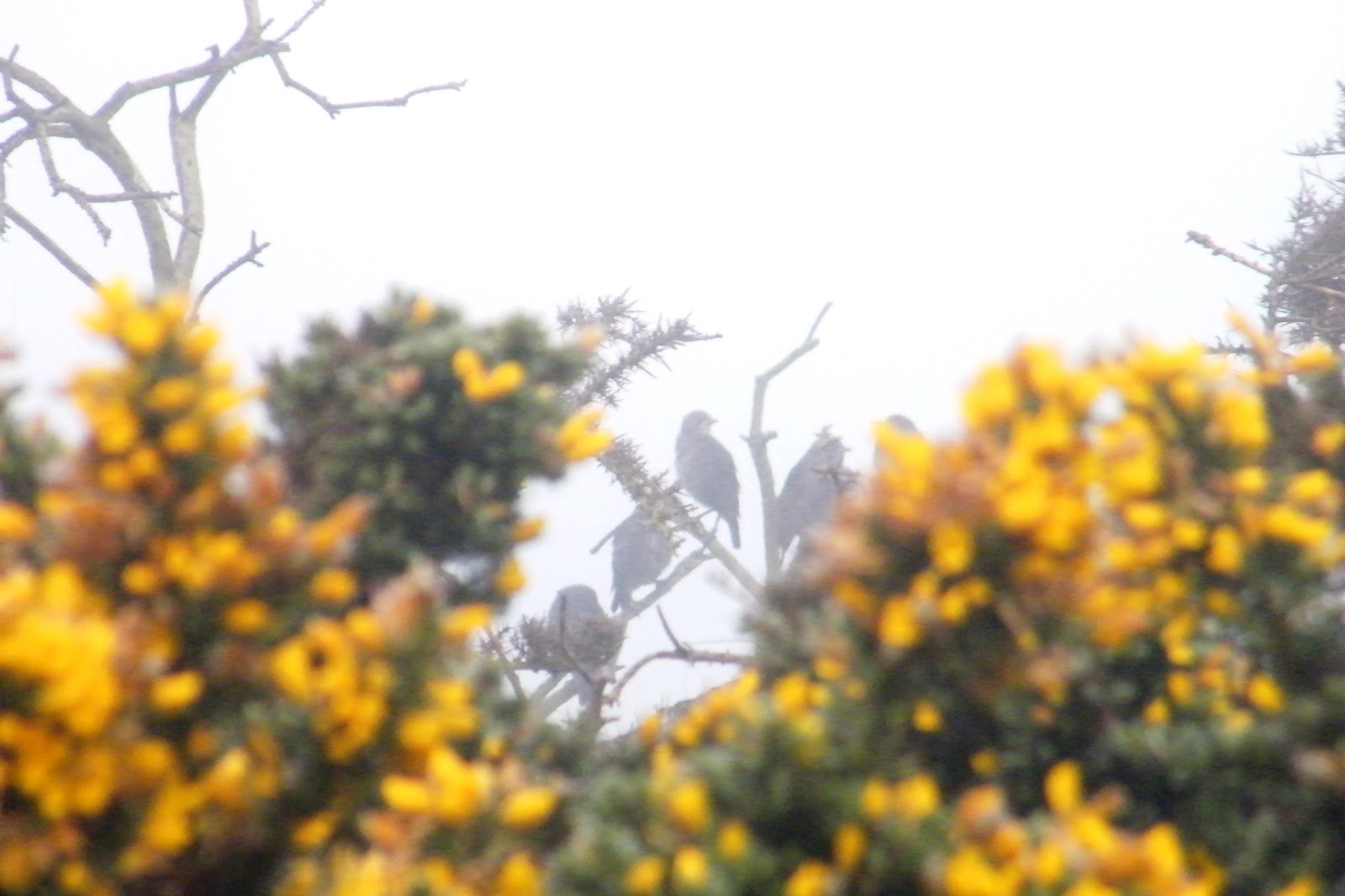
unfurling over stone, into starlings

spreading back into the whiteness
of the water indivisible 
and overtaken by the sky

Friday, June 15, 2012

last year in taatta

sunset on the road at tüngülü, menge khangalas ulus, june 2011


These are photos I took almost exactly a year ago, last June, when I was still in Sakha, and hadn't yet lived one of the most difficult, surreal years of my life. I was nearing the end of 10 months in the field, and that was a strange time too; I was anxious and sick and weary, and frustrated, too, yet sometimes now I find myself thinking of these people and places with a smoothed-over, glowing nostalgia. I wish I was back there, sometimes, with all the confusion and overwhelmed-ness that life doing fieldwork in Siberia entailed. I wish, above all, I could have appreciated the moments there more, without worrying so much about what I was doing; wish I could have dwelt with ease in a succession of presents without feeling so scattered across time, across space. But considering my father's (lack of) health at the time, considering what I was carrying with me (that I always carry with me), I am trying not to be angry with myself, trying to be compassionate to what was roiling about within me at the time.


we are in a very old church tower, chörköökh, taatta ulus, june 2011

I am lucky I got to create some beautiful relationships, and explore lives, share with people in Sakha. As difficult it is right now, to think too far into the future (months at a time, now) I do look forward to at least planning a visit back there in less than a year's time. Even if I felt out of place, never fully connected during my time there, now I am beginning to understand the impressions made, what my experiences there carved into me. The parts of the place and people that moved into me, and those into which I moved. I didn't fully comprehend them at first, these pieces I carry with me, but they are becoming clearer and sharper now. These realizations have emerged gradually, but now it seems that I am stopped mid-thought by their clarity: it's like how you must hear bird songs repeatedly before you come to associate them with their singers, the way they suddenly begin to come forth from a background of muddled, inchoate sound and call to you singularly and simply, like newly-learnt words in a language emerging from the chaotic flood of speech. Like the moment when you begin to feel a language becomes something you can really live in, not only something you use.


chörköökh, taatta ulus, june 2011


Yesterday, I spent the afternoon talking with my supervisor's cousin, Saaska, who was visiting Scotland. He's from Sakha, with roots in Taatta, the place where all these pictures were taken just a year ago. He's a kind, funny, serious man, a shaman of sorts, a ritual specialist. An algyschyt, perhaps to be most precise: a blessing-giver. And many of the blessings he bestows are those of sound. Of music, played on the khomus, most beloved of instruments for Sakha people. It heals, he says, it's good for you. It has the same power that some shamans would traditionally carry in their drums. And we talked too, about speech and silence, the powers they can carry and convey to us.


field in an alaas near chörköökh, taatta ulus, june 2011

One of the most important beliefs for many Sakha people is that language is ichichileekh; that is, words possess a spirit, an ichchi, the same as a river or place or a fire. Saaska told me that part of that spirit arises out of the sounds themselves, the resonance of vowels, and part of it from the intent of the speaker. His thoughts on it sparked something brilliant for me in terms of the structure of the first chapter in my dissertation, but perhaps more crucially, they reminded me of why language (and studying it, learning it) inspires me so, and why I was drawn to anthropology over linguistics. That words are magic, that they carry a power with them, inherent to what they CAN do, and there is beauty in their linguistic forms--those permutations of sounds, and their morphosyntactic weight--but there has to be the speaker to fully realize their power. A word is empty without the speaker, and  a speaker needs that system to make meaning.


birchbark baskets, chabychakhtar, in a summer dwelling, or uraha, chörköökh, taatta ulus, june 2011


I always knew that I left pure linguistics behind because there were no people in it, but what Saaska clarified for me about how words possess their ichchi illuminated in a way that solidified my reasoning. And it gives me the push to take the hard stance on it and remind those generativists that you know, you can't study language without people. And just studying their brains and those synaptic potentialities doesn't count, Chomsky and Pinker et al.; it's like trying to sever body and mind. Your 'pure' science, formal linguistics, is fundamentally incomplete until you take into account the context of every utterance, the whole of communicative practice, the spirited word. You cannot have one without the other, at all.


so many sylgy n'urguhuna, chörköökh, taatta ulus, june 2011


But Saaska, yes. So nice to speak with someone who knows Taatta, knows this place that I never spend so long in, but felt so deeply. Such lushness, there in the early summer, between two great rivers, the Lena and the Aldan, up at 62 degrees latitude an oasis dotted with alaases, Sakha heartland, home of the word. Place of so many respected olonkhohuts, those who recite the epic Olonkho, and so many of those who first put Sakha words on paper, the first Sakha authors who suffered so much under the Stalinist regime but whose words are still heard.


sacred tree, an al-luk-maas, with offerings, orthodox church in background, chörköökh, taatta ulus, june 2011


 sylgy n'urguhuna (wood anemone) and sir simeghe (forget-me-not) in oyuunskii's alaas, taatta ulus, june 2011


I was not long in Taatta, but I think perhaps because of two particular days there I remember it so well: one of the worst migraines of my life, complete with panic, aphasia and vomiting that culminated in an injection of some very heavy painkillers from the village doctor, a woman who in my delirium I accused of being the 'horse doctor'; followed by one of the most idyllic days of that year, in which I traipsed through the countryside with good friends, visiting places where they grew up, and then lay upon the earth listening to the birds, eating fresh food (oh my goodness the butter, and the wild garlic), bathing in a banya, and feeling some of the first flickers in what had been a long while of feeling good, and whole, and pure. And a feeling of re-inspiration, of remembering why I was doing what it is I do. And somehow I feel now that encapsulates the whole fieldwork -- the struggle, and then the re-dedication, the reward.


horse in oyuunskii's alaas, taatta ulus, june 2011


weeping birches + sunken bridge, oyuunskii's alaas, taatta ulus, june 2011


I mentioned Saaska's explanations about why tyl -- ichchileekh (language has a spirit) because remembering that re-inspires me too, especially at a time when I am amidst the slogging of writing, the fits and starts, the flows and barriers of trying to construct a doctoral dissertation. When I am pushing myself to remain submersed in the middle of my notes, my data, and produce a narrative out of months of accumulated experience, and at the same time live the uncertainties of an early academic life, where I am also forced to constantly plan ahead, plan where money will come from, plan the next steps in a path that I am ultimately not quite sure of, within the confines of a socio-economic climate that doesn't really place a high value on the work that I do.


a kulluruut, or wood sandpiper, in oyuunskii's alaas, taatta, june 2011
forget-me-nots, an old serge at the balaghan in platon oyuunskii's home alaas, taatta ulus, june 2011


I question what I'm doing a lot, its meaning and sense, and why I put myself through what I do. Why I ever thought it was a good idea to do what I'm doing. Why did I decide when I was twelve years old that a PhD and a life in academia was what I was going to do with myself? I knew nothing then, nothing about that, nothing about anything. I know a little more now. I try to remind myself that deep down I know that what I am doing has significance, that it can be meaningful. That I can give it meaning. Tyl -- ichchileekh. Language has a spirit.


memorial monument to platon oyuunskii, one of the first sakha writers, at his home alaas in taatta, june 2011


monument to an olonkhohut, rest stop at the border of taatta ulus, june 2011

I do believe we need to understand how language works, how communicative practices shape us, and how we shape the world through language. Shape our relationships, the way we relate to each other. Shape the transmission of knowledge, and ideas, and meaning. And I think there's a lot to be learned from understanding communicative practices in the context I'm writing about, in a northern place, through the lens of mobility and changes, of resurgence and resilience, of following trajectories and reflecting on how they shape peoples' lives in the midst of social processes on a broader scale. I think it's worth something, to learn about these things and to transmit and share that knowledge with others, to teach. That's something I know I want to do, along the way.


al-luk-maas, the world tree. yhyakh site, ytyk-küöl, taatta ulus, june 2011

wagtail on the serge in the yhyakh site outside ytyk-küöl, taatta ulus, june 2011


Of Taatta, I remember the sound and silence of the field. The wind in the grass like the sound of the khomus's tongue plucked. The cuckoo calling, the soft snorting of horses, their footsteps swishing in the green spilling out across the alaas like the memory of water. Saaska and I also talked about silence in relation to speech, and the fear of silence in many cultures that leads people to try to fill it with half-formed, ill-thought words for the sake of making sound, and he compared this to the way some people try to fill a silence within their mind by immersing themselves in surface noise, material distractions in most cases, because of that terrifying quiet. 'So then they will have all these things', he reasoned, 'but then they will not hear the sounds that matter'. 


o. by the taatta river at the rest stop between taatta and churapcha uluses, june 2011


I try not to listen to criticisms of what I do -- the endless questioning of what I am going to DO with a PhD now, of accusations of the ivory-tower cloisteredness -- because I do believe that understanding how people speak can tell us a lot. And it sounds simplistic, but I do often retort to those who insinuate my work is useless that they should think about how we might accomplish things (you know, building fancy bridges or cars or being lawyers, etc, all the valued professions that deal with money, and basically anything at all) if we did not possess linguistic abilities. So, you know, it might be a good idea to understand what communicating in certain ways might mean to people, yes? I am not trying to say that being a researcher and teacher of/about communicative practices is better or more noble than anything else, but I am indeed saying that it's just as essential as any of these other jobs. That's all.
cows and horses grazing by the side of the kolyma road, tüngülü, menge-khangalas ulus, june 2011

Saaska said, 'I like what you do,' meaning me and his cousin, my supervisor, as anthropologists, 'because your job is to listen to stories, to socialize and converse, yes, but always to listen'. And I don't deny that it's always nice to hear that about your chosen profession, but it strikes me particularly because those words really served as a reminder to me of the dialogic aspect of language, of again, how the analysis of language as interlocking syntactic systems is nothing really until you consider it in relation to other parts of that system; how existence itself is dialogue. I learned during fieldwork how the old pre-Russian-contact traditional Sakha greeting, kepseen! (speak!) emphasized the invitation to dialogue, to share the the sound and spirit of the words: let them fly like birds out into the spaces between us. Tyl dorghoonookh, tyl ichchileekh buolar. The word has sound, and so it has spirit -- and I will always listen.


o. waits for the ferry on the east bank of the lena river, june 2011