Saturday, October 08, 2011

a shop full of stones

Necklaces, September 2011.

So, I finally made an online shop in which I have offered for sale some of the beads I've been making all summer. You can go visit it here, on Etsy, to see more of the above sorts of adornments. Most of the beads and artefacts are things I have gathered or inherited; the only things that are really new are the brass chains (so they are pretty sturdy!) The pieces are all connected to Ukrainian-Carpathian aesthetic; whether made of vintage beads from Ukraine or consisting of more-newly-acquired amber and carnelian, the colours, shapes and forms are all linked to the folklore and material culture of the Hutsuls and their neighbours. I have so many treasures that sit in little wooden boxes in the basement, beads and rocks and trinkets; I wanted to take them out and refashion them, recombine them and let them be worn.

These paintings by Polish painter Kazimierz Sichulski for an idea of the Hutsul women's ornamentation that I am inspired by:


A Hutsul Bridesmaid

HucuƂka, 1906

Hutsul girl with a bouquet of hearts, 1906

Tuesday, September 27, 2011

the heart of the world

This is my father, and a rainbow trout, somewhere along Carson Creek, in September 1976, when he was 28, the age I am now.

My father passed away a month ago today. He was sick, yes, for years, but this happened suddenly, too swiftly, as unexpected as it could be in this situation.

And that was at the last of the summer, and it's fully autumn now, just like in that photo; the leaves are half-turned, shaking their gold flecks all over the hazy blue stretches of sky between the hills. We've had warm days, too warm for this time of year, everything ripening slowly, bringing a richness that nourishes me but aches more than I can ever remember.

Because it's an Indian summer, a grandmother summer -- but it should be a father's late summer, when he should be standing in a chilly creek somewhere in the northern foothills, rapt with lungfuls of warm juniper-scented air and the sun singeing the back of his neck.

There is a breeze that skims the surface of the flow, over the moss, the steady rush over the quiet rocks. A single shed moose antler tinged red by the tea-coloured water. There is the aspen shake, the flutter of the fishing line, and his unshaven face squinting into the long late light of the afternoon.

I am standing there, knee deep, a little ways off, with my camera, thinking about all the places he has led me, down cut-lines and fire roads, and what he has given me there, what I have inherited, what we have shared.

* * *

There's a strange little song called The Beginning of Memory by Laurie Anderson, in which she narrates a story from Aristophanes 'The Birds'. In the beginning of the earth, all sky and sea, there was no land for the birds to light on, so they simply circled:

...one of these birds was a lark and one day her father died.
[...] what should they do with the body?
there was no place to put the body because there was no earth.

and finally the lark had a solution.
she decided to bury her father in the back of her own head.
and this was the beginning of memory.

It is in this way, through the process of the making of memory, that he lives on; he lives in me, both physically and emotionally. Even in the midst of this surreal month, in this strange liminal space between his presence and his absence, I have felt him in the muscles of my thighs as I ran, I have felt him somewhere in my gut, a melded intuition, when making decisions.

I remember the end of September six years ago when he was first diagnosed with myeloma. The weekend before he started chemo, he wanted to go driving. And so we drove up to Whitecourt, but didn't go fishing; we passed through the town, and he showed me where he'd lived when he first taught there 35 years before. Showed me where he got lost in the bush, where he first explored the trails, rattled down the gravel roads in an old Challenger, blaring the radio when they played Spirit in the Sky. We drove down the forestry exploration roads, rolling with golden larch and aspen, under a sky gone cobalt with a lost late thunderstorm, stopping to photograph things: a bridge canopied by the flight of hundreds of swallows, the swarms of migrating butterflies hovering too low over the roads. We checked the water levels in the braiding streams, investigated the trapper's cabin ruins, stretched our legs.

We'd done this many times before, for years we'd be wandering around here with fishing rods and cameras, but it seemed especially important this time, deliberate even in our ramblings. Though we spoke little, he was telling me stories, telling them once more to himself as he remembered these places and times. This was a conscious remembering, a careful, attentive trampling of a long-worn path to keep it fresh, and to show me that trail's significance so I could re-member it and tread it myself, to understand the way he had experienced it throughout his life but also to illuminate the way we shared it together.

And all I can do now is take what I have dwelling there in the back of my head, all those paths and places and run though them, these memories, to re-member what's there, manifest it as I continue to do the things he loved so much, that he has passed on to me.

* * *

“As long as I live, I'll hear waterfalls and birds and winds sing. I'll interpret the rocks, learn the language of flood, storm, and the avalanche. I'll acquaint myself with the glaciers and wild gardens, and get as near the heart of the world as I can.”

- John Muir, in 'A Thousand Mile Walk to the Gulf'.


Tuesday, August 16, 2011

makings

This is a picture of an old Hutsul woman that I found (original source unknown) and she is all kinds of amazing, I think.

It's been a bit of a long break here, but I am still writing, or at least planning to write. Home in Canada, trying to re-culturate and prepare for departing again to Scotland come mid-September. Dealing with family illness, trying to start writing my dissertation but not being able to gather thoughts in any semblance of order.

I ache to write but can't organize my thoughts very well at the moment, due to anxiety & too many things pressing at the vessels in my mind, so in the meantime I've mostly been making things with my hands: cabled handwarmers, felt mittens embellished with beading I did three years ago in the Yukon, tiny embroideries (though I had to stop the latter because my paraesthetic fingers and tired eyes protested). And beads... I've rediscovered how meditative it can be to pry at wires and string things along without any real plan, just adding and removing until my aesthetic third eye feels that telltale warmth and satisfaction.

I was of course inspired by the incredibly ornate silver decorations of the Sakha ladies, with their tiers of amulets protecting all parts of the body from evil spirit-influence, but what I am making with my own hands is simpler and less crafted. Wandering around the Museum of Ethnography in St. Petersburg on my way home I fell in love with the ancient amber necklaces of Baltic women, and the paleolithic pendants of bone and mammoth ivory, and after seeing the myriad strands of rough amber in the market stalls, decided these needed to be recreated. Combining that with the Carpathian colours, the warm reds of coral and carnelian and the raw brass and copper zgardy, I am making jewelry that reminds me of these elements and histories. I found stray vintage beads from Ukraine and antler tips from the Yukon in my treasure boxes and then bought some unpolished crystals, and thus many afternoons lately have been spent not thinking but simply making, inspired by these remembered patterns and textures and aesthetics. Pictures soon.

Sunday, May 08, 2011

mother's day!

Mama at Thanksgiving, October 2009.

Mama at my age. She has shared so much with me, but didn't pass along the prettiness genes to me, alas!
Mama at age 4 or 5, with one of her many kittens named Tiger.

Happy Mother's Day to my mama -- she is the reason why I love language and words, why I travel, why I have the resolve to do what I do. She is the reason I want to be giving and generous, the reason I want to not only learn but teach. She is kind and tough and gentle, and I am so proud of her for all she has accomplished, for all of her perseverance and quiet resolve. She has helped shape my ethical and philosophical development, esp. the feminist and altruistic elements, for which I am deeply grateful. I immensely admire her resilience and her selflessness more than I can properly express, and I wouldn't know what to do without her strength and her support.

Mama, I am proud of you, and I know your own mama is too. Not to mention our horde of resourceful, brave and rabble-rousing ancestors -- from what you have taught me about them, you embody all that they aspired to, all they qualities they held so dear: resourcefulness, endurance, independence and the ability to always look forward, and cultivate hope.

Monday, April 25, 2011

aspen engine


Oh look, it's my favourite motor vehicle again. (See also here, and here) I've been documenting its life over the past five years, and I finally finished a poem about it, that had lived in scraps for months and months.

* * *

aspen engine


when the car stopped driving

it rolled to rest in the back

forty, by the poplars at the edge

of the field. dead, they said.

no longer mobile. but within

weeks of abandonment,


an aspen engine slowly started

up, ignited this reclamation:

silver shoots pushing up amidst

stalled machinery, fingering the

shattered hood. eyes pried open,


& soon headlights emptied into

small portals for sparrows & the

chassis, a trellis for the twisting

blossoms of vetch. sunprinted vines

on the dash’s bleached plastic, rusted

springs of seat cushions swallowed up


in mossy upholstery. paint flakes

cling like periosteum & colonies

of sowbugs beneath the moist

deadfall of the brakes, seethe

like the memory of friction under

the foot of a driver’s ghost. now


only lichens creep with their slow

feet across the dusty windshield,

silvering filaments clustering,

mirroring the passage of clouds.

in its very heart, void of motor


the three trees grow: a burst

of new limbs to cradle the hull

as the rust comes chewing

small lamellae, claiming the skeleton

as carboniferous leaves fall in the

gravity of metal to earth. & so


this grove no graveyard for that

little green datsun, no scrapyard,

no junk heap. this is a plant,

a factory of deterioration, just a

shift in direction, shift into reverse.

Sunday, April 17, 2011

fieldwork and difficulty

sunset in the pines near sergeleekh, yakutsk, april 2011

So, I just read this article by Amy Pollard about anthropological fieldwork and difficulty, after coming upon a reference to it in an old notebook, something scribbled down at some pre-fieldwork seminar last year. And I just read it, & I am really torn as to whether that was a good idea or not; as much as it made me feel better about how I am currently feeling, it also made me feel worse. However, I am also feeling deeply grateful for this article, because I think it is a brave and necessary piece of writing, and it has allowed many anthropologists to speak about their experiences that they previously felt were unmentionable and had no place within anthropological discourse or even the discourse of academic life.

The section in Pollard's article regarding depression resonates so strongly: "Students criticised themselves for feeling depressed, and were criticised by others. Several students said their informants told them not to feel so sorry for themselves, saying that they were not going to be able to carry out research if they did not cheer up. Maria described how depression stopped her from feeling really interested in her fieldwork site for 12 months. Looking back, she was disappointed at the “very mechanical way” in which she had done this fieldwork, and resented the mental turmoil which had precipitated her depression."

And it's difficult, because I don't know what to say to some people when they ask me about life here, because a lot of people at home think that fieldwork is: a) basically just like going to school in another country or b) a grand travel adventure of hanging-out funtimes or c) both, and when I was last back I could say, yes, my research is... going, because it is going along pretty well, and yes there are lovely, kind people here that I am acquainted with, and I appreciate them very much and I think that everything will be fine in the end, but there is so much I have trouble expressing, to both people at home, and the people here I've come to befriend, like:

1. Dealing with a bureaucratic system so fucked up that sometimes I feel like I am in a combination of a Sisyphean nightmare + a Monty Python sketch (only decidedly not funny).

2. Trying to be assertive and anticipate when people who I think I might trust are trying to manipulate me or at the very least, take advantage of me. Giving in to demands when I should say no, then feeling guilty for not refusing.

3. Trying to explain to people, esp. other academics what it is I am doing here when they have already have very stubborn idea in their mind of a) what I am doing here and b) how what I do is not terribly worthwhile, etc.

4. Trying to explain my struggles with depression and anxiety in languages not my own, within a cultural context wherein these feelings are not often expressed and these problems dealt with very differently. (Here you do things unless you are actually dying. Haven't slept at night in days? Migraines with vomiting and aphasia? Not good enough.). The amount of energy it takes sometimes to present myself as an enthusiastic, inquisitive, flexible, useful fieldworker (teacher, helper, etc.) is more than it usually takes at home to do the whole performance thing.

5. Feeling the aforementioned depression and subsequently full of a strange sort of ennui, and then feeling guilty for feeling that way, because what is there really to be depressed about, you privileged, fully-funded, over-educated, ungrateful excuse for a serious anthropologist? You wanted to come here! etc.

6. Feeling so frustrated because I want to relate to what I am doing on a more profound level, but it just isn't happening. Of things not meeting your expectations or hopes. As well, I think half of my heart/brain is at home, and only half is here, but I am not willing to detach that other half. I can't.

7. The feeling that I am neglecting myself and my well-being in general, combined with the feeling of something a bit like Stockholm Syndrome wherein I try to justify to myself the troubling behavior of others here or the broken systems as not so bad after all.

Also, the thought of coming home unnerves me too. Because I know this has all changed me. I don't feel like myself right now, and part of that could be the depression speaking, but I also know I have changed in ways I can't even pinpoint, and I really don't know how to articulate many of my experiences. One comment in the article was "You leave and you can't really come back". I think that's true of so many sorts of leaving, and I've done a lot of leaving over the past couple of years. But I do feel like distances are growing between many people in my life, and I am not sure how to remedy this. I have been trying to keep contact as best as I can but it's difficult when both of us aren't trying. I really can't fathom how I am going to give the tidy sound-bite version of this year as expected this summer. And there's a silencing there.

Coming home also means the pressure to start writing, which at this point is starting to feel more real. (And I am afraid, because I wonder what I will write, and how much I will write and whether I will have enough to write about in the end, because look at me, only in the field for not even a year and some people go for a year and a half but I have to finish by Spring of 2013 because of the draconian British PhD laws and what if what if what if)

So while reading that article brought a certain relief and feelings of vindication and solidarity, it also makes me feel bad because as much as I can certainly recognize of myself under those ominous word-headings, I also feel weak for having some of these feelings. Yes, there's the whole ideology-of-difficulty aspect of Anthropology; I feel the pressure to do fieldwork like it's some grand feat of MANthropology that I must endure and get through with great stoicism. There's a lot of guilt and worry over my own performance, and trouble discerning what I can control and what I can't. As one person mentioned, "I felt it was all part of the rite of passage that people have to go through. [My fieldsite] was supposed to be so easy and civilised. I never felt able to say I was having a really hard time". That summarizes it well, the "Oh, but this is all just part of fieldwork!" argument that others use-- and that we use to convince ourselves. But at the same time, I also recognize that my situation has been infinitely easier than that of many other PhD students mentioned in the article. Exacerbation of my existing health problems certainly beats malaria or dengue fever... (Though the rabid dogs here have been putting me on edge lately) I have dealt with harassment and misogyny, but that's nothing compared to sexual assault. I do not fear for my life, or the lives of my friends here; I am not in immediate physical danger... though I am haunted by my father's illness at home. & I have the Internet when I am in the city and I can easily get in contact with my loved ones by phone, too. However, this also contributes to feeling silenced. “I came back and heard other people’s stories and thought [my experience] was kind of nothing.”

These are things I know I will be thinking on for quite some time, yet, I know. However, this article did provide me with a difficult but much-needed sort of solace in light of how I have been feeling as of late. And I am thinking I might pass it along to people to whom I am having difficulty explaining both fieldwork in general as well as my own experiences here, with the relevant parts highlighted... (and likely, the disclaimer that "Oh, but don't worry, it wasn't really that bad".)


Saturday, March 26, 2011

photo show

Recently, some Northern Studies friends here at the University in Yakutsk put together a little photo show at a gallery here in town, in order to promote their department and display all the lovely images collected by students while studying and exploring northern places. They invited me to include some photos of Northern Canada. I gave them a selection that I chose quite quickly, with some of Alberta and some of the Yukon, and they decided to display the following four... Interestingly, all of the chosen ones ended up not being truly 'arctic' latitude-wise, but are from the Rockies & the northern Alberta boreal forest... Nevertheless, here they are:

I am happy one of my hungry waxwings was selected...
(my neighbourhood, Edmonton, Jan. 2009)

Sunset on the Lesser Slave River, Alberta, August 2010.
Magic hour! I love the little luminous cloud in the top left.

The canonical Lake Louise view; I was surprised this one was selected because I didn't think it was the most interesting. However, I like the effect of the forest-fire smoke making the background hazy... (August 2010)

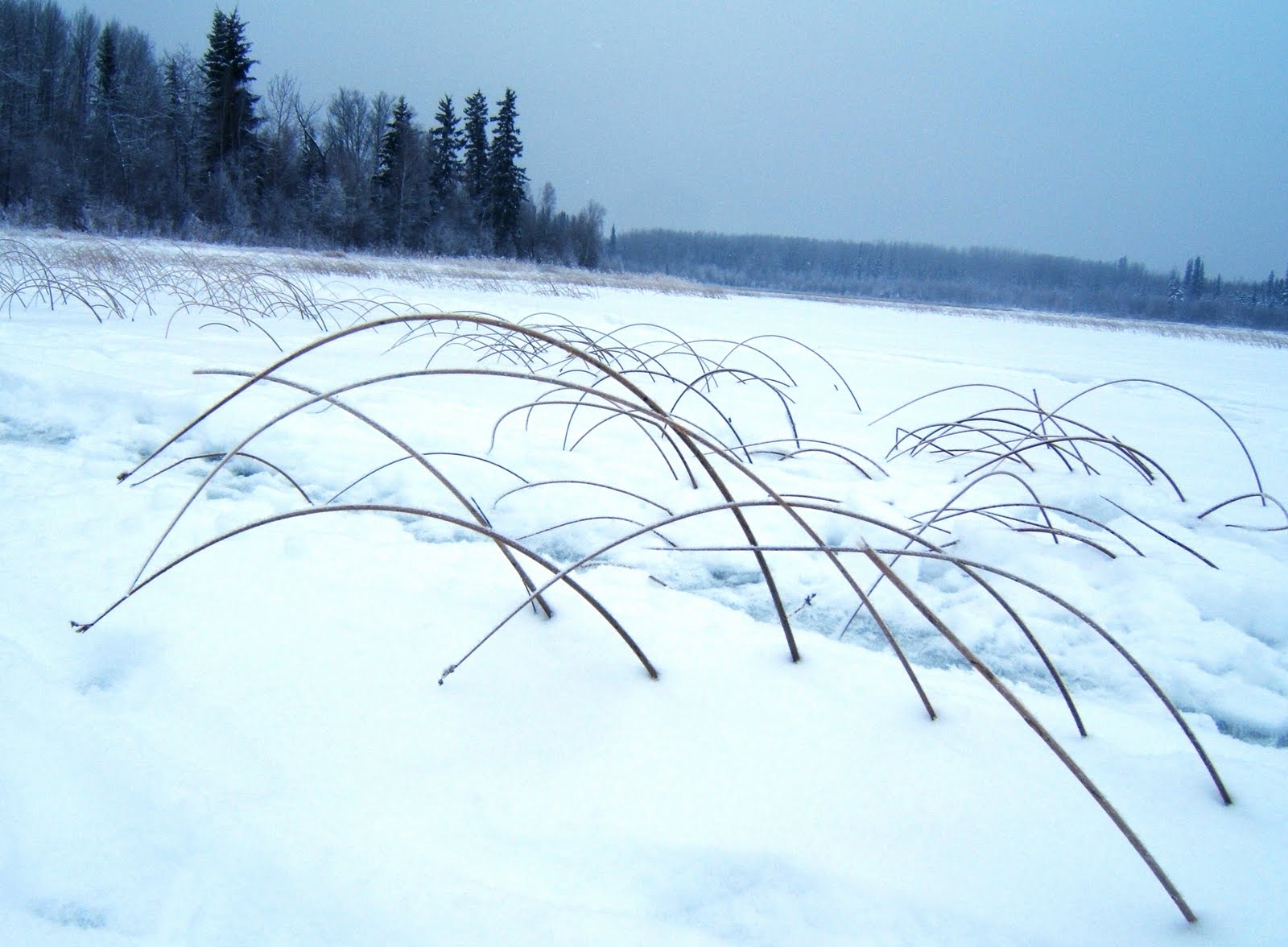
Bent sedge-grass at the edge of Lawrence Lake
(near Athabasca, Alberta. March 2009.)

Monday, March 14, 2011

paper cravings

river-breath frozen to a branch, Athabasca River, Jasper, January 2011

In the midst of doing research here, & living rather simply (as in, my collage-box is precisely 6046km away from me, & I have pretty much no access to art supplies here), I am finding pretty much all I want to do is make things. Particularly things that involve the cutting & gluing of paper to accent the theme of words on a page, i.e. poetry chapbooks.

I have been knitting madly, which fills a certain need to do things with my hands, and this is good, and I have been trying to do more photographing, but I also have all these poems that want to be on paper. Paper in books that I can give to people! I haven't made a chapbook in years (I was about to manufacture one in Fall 2009, but then I left for Scotland, again without the collage-box) & there is one all ready & waiting to be made, & I think another one is starting to come into being. I also had another idea for a little book I want to make, about all the lovely people I know who make stuff with words & pictures & cloth & yarn & sounds & such.

I also want to make prints of so many photos, & put them in wooden frames. I want to make collage posters of poems... I want to go to an art store & feel all the fancy book-papers, the ones with thready textures, & the soft-rough edges, & the filmy Nepalese lokta leaves... I want to watch ink from the fountain pen my mother gave me absorb into the fibres... & then I will glue wool and buttons and cut-up photographs everywhere amongst the words! And rejoice!

Oy, such a longing... When I get home in the summer, one of my first plans is to make and eat a grilled sandwich with avocado, smoked tofu, & spinach with hummus on the side. Then I will sit on the floor somewhere & cut & glue things until I am sated.


Wednesday, March 09, 2011

habitus, part two.

me in jasper, inhabiting the snowy woods. january 2011, photo by jason.

The word 'habitus' is a lot like 'habitat', and it always makes me think of a place -- the coziest, most natural little nest-niche of a place where you feel utterly at ease, at home. However, as early anthropologists and sociologists developed the term, it came to encompass all of one's cultural practices that are part of the body, the daily practices -- the non-discursive knowledge we absorb through socialization (our family upbringing, often tempered by formal education), which is then rooted to a place, of course. It is everything from tastes and bodily positions and styles and habits and routines; basically, it is all of those things that never need explanation, and perhaps evade explanation. And so we never think of them, but we always know when they are absent, when our habitus does not align well with those of others, & we realize when our own habitus has been thrown off its centre.

This is because, according to Bourdieu, the habitus is our schema, a bare skeleton that fleshes out with all our lasting perceptions, thoughts and actions. And this is how we relate to a field, a social structure or space -- through this inhabited body, this habitus.

Since arriving here in the Sakha Republic last September, I have been observing the little changes I have adapted to life here fairly well under the circumstances, I think, but I still feel off-kilter, and decentred. Of course I miss the people I love, the people to whom I can truly reveal myself, to whom I am not--when all is said & done--the foreigner, the fieldworker, the academic (even if we get along well)... I miss certain foods, as well, everything from green vegetables to the taste of tapwater in my hometown , the usual things that travelers and expatriates miss.

But I also notice more subtle things, these aspects of the habitus that are difficult to isolate. They are all tied up in how I walk differently here, much more tensely and apprehensively. How I interact with people differently (I am less assertive but far more outgoing and enthusiastic), I miss the sort of polite friendliness you can show to passing strangers and workers in Canada, but is out of place here in Yakutsk. I miss feeling a balance of power within an interaction, of feeling like I am being asked instead of told. It tires me to have to always have to fight and repeat myself to express my needs, to untangle these nuances that no one ever explains to me--never even thinks to explain-- because to them, they are part of the habitus of this culture, this place.

It's the knowing that I will always fit out, on the deepest level, even if I fit in superficially, even if I am certainly adapting, often subconsciously, to this new habitus. How I dress, how I talk and interact (requests, questions, everything), how I walk, how I approach someone. I just miss my own habitus, because all these little things add up to a larger incongruency, & I don't feel real sometimes, just not quite like myself.

And maybe I think too much, instead of just trying to be, but thinking too much is really my job right now, & so is noticing all of these things, I suppose, because in subjectively understanding the changes in my own behaviors, I can better identify what it is that characterizes the habitus (especially as it relates to communicative practice). And maybe this is different, what makes me stand slightly apart from someone moving to another country to live, to make a life, rather than to study it in minute detail -- do they notice it quite like this, beyond the initial, more overt symptoms of culture shock? I don't know. It just makes me tired, sometimes, this creeping sense of dépaysement (another lovely French word that describes how things in another country, another place, never seem quite right), which I think links well the nostalgia for a place with the longing for how you feel when you are there, when you inhabit it, you dwell within it -- a sense of (in)habitus.


Monday, February 14, 2011

habitus, part one.

i am in my home. photo by jason, december 2010


Some nights
I just never go to sleep at all,

and I stand,
shaking in the doorway like a sentinel,
all alone,
bracing like the bow upon a ship,
and fully abandoning
any thought of anywhere
but home,
my home.

-- Joanna Newsom, from 'In California'.


Saturday, February 12, 2011

baba yaga is my patron saint.


kalyna berries, aspens, birches... top photo by me, bottom photo taken by jason. riverlot, december 2010.


Last month, Sady Doyle, wrote a wonderful post about Joan of Arc on her blog Tigerbeatdown, which is fantastic, & you should read it if you don't already (that post for sure, because it's one my favourites, but all of the blog, really!) & it inspired me, because I have been thinking of Baba Yaga a lot lately, especially as a feminist icon, and an example of patriarchal structures and those who enact them use certain methods to try to bring down powerful women, & how these methods haven't really changed. & there's this bit where Sady discusses the process of picking out a Catholic confirmation name, and choosing Joan as the patron saint she'd like to have her back, which made me smile, because, yes. From what I know of this girl and her activism, it suits her perfectly.

Anyway, of course Baba Yaga in any incarnation never has & never will be canonized, but I still wish she was my patron. & so I imagine her as grandmother and protector, dispelling the myths spread to slander her, grinding the patriarchy to a pulp in that mortar & pestle.

Poem, as usual, in progress:

i)


baba yaga is my grandmother,

baking bread by morning:


she kneads her mottled heart,

offers it to the oven: all day it rises,

each pulse powering


the bellows that the bellows that set the forest

breathing, her avian hut

slowly stirring with the day.


she works, and works, arms a

a sinewy genealogy, layers of onion-skin

windowing over veins tracing paths,


remembering: a loaf for my mother,

and my mother’s mother, one for my

grandfather and another for the birds.


late afternoon, she shakes out her linens,

magpie wings as she flutters out, all

walnut-kneed and juniper-eyed,


from tree-tops she watches winter sun

soak the river fiery, turn the coals

in the dark furnace of her woods.


ii)


baba yaga is my grandmother,

even though she has no children.


those she shirked retort

that she’s just a spinster, a

dessicated pestle-pusher


but i have seen the red rider

leaving hoofprints in the yard

at dawn, & her corvid voice creaking


& lilting as she gathers herbs,

smirking:


don’t tell your mother

i’ve been teaching you bawdy songs!


iii)


baba yaga is my grandmother,

although no one believes it.


she’s not even a woman,

they scoff. village men say

she drinks the blood of livestock,


devours our children! robs

every nest, corrupts them, crazed

barren woman, bitter and unfed;


look at her fence! they cry,

(mistaking brambles for ribcages,

silver birches for weathered bones.)


they never remember

how all the women call for her,

have her cure their difficult infants,

coax them down that red-poppied

path, spin their linens, save their lives.


the men scorn, but she knows

their need, & how in times of

desperation they remember


that psha krev dog’s blood

is just a curse for a burned hand.


iv)


baba yaga is my grandmother

& also probably my great-grandmother.


those skeletons? she says,

those are my only relatives:


they said, bury me here, baba,

i will be fodder for your sunflowers,

i want asters & yarrow to blossom

from the hollows of my eyes!


baba shakes her head,

a handful of rich dark earth

in her fingers: everything we eat,

you know, is of the dead.


v)


baba yaga is my grandmother,

bright forest inside of me:


& they said she is death

but i know it’s more dangerous

to create


with a mortar with a spindle

with a sharp flint spark!


to crush harm like poppyseeds

into numb paste on your tongue –


forget the macabre lanterns,

she says, you won’t need them

in the dark:


every night she sends me off as

my own talisman,

my whole skull blazing with light.

Tuesday, February 01, 2011

geological poem #2

fossil crinoids, jasper national park, july 2010

fossil corals and other creatures, kananaskis, july 2010

When my grandmother was in the last years of her life, she often retreated into memories of her early years; she spoke of relatives and friends long since passed. English slipped away into the background, as her first language seemed more suitable for telling me about people like her grandmother whom she'd only ever known in that language. The present moments were a gauzy blur to her, and this frightened her; they were much less clear than the past times that had suddenly flooded into view, carrying her into a comforting future where she believed she would live amongst those personages again.

When my father found out he was dying, his interest in geology saw a striking resurgence. He studied it in university before becoming a teacher, and throughout my childhood we were always hunting fossils and inspecting outcroppings. However, a few years ago, he became immersed in tomes on stratigraphy and sedimentology again, and travelling in the mountains became a time for him to recite the epics of terrain formation. This past summer we drove southward through the mountains from Jasper to Kananaskis and I learned pretty much everything about how the middle Rockies formed. He reveled in telling me every detail, as he was parsing every pattern of thrust faults and reconstructing each shattered slope, reading the rocks, the story of their genesis. And it occured to me that this recounting of the story of creation, the slow transformations that made the world was a deep comfort to him; in this time of certain uncertainty, of living daily with an illness that will kill him, it calms him to dwell on understanding the story of the forces that move the earth beyond us.

* * *

when my father fell ill, he

starting reading the rocks:

in every surface crack he saw

the seismic shift in his own

marrow, a mirror of his slow decay:


it’s in the barest wavering of fingers,

pallid colour of the dry rock face.

in this sickness, he says, there’s

no great landslide: i erode.


it’s the slow slip in a steady

rainstorms, persistent wind

twinges, the shake of dead cells

rattling in a cave of riddled bone.


one by one those fragments gather:

infinitesimal ions seeking each other,

pushing through the cloudy morion,

migrations replacing the base.


my bones, he says, are no carbonate.

they’re quicker, like young clastics:

bodies of scrappy particles gathered

on land, wreathed & jointed by water.


we are all cobbled creatures, sedimentary.

clay in shale, siltstone, gritstone, gravel

and sand. smashed together by the whim

of the river & the wind.


& so he softens, despite himself. despite

the heart still quartzite, pulsing intrusion

into the limestone, those mountains of

small lost things:


crinoids and lilies and three-lobed water

insects, mollusc mantles and coral rings.

repetition after repetition in the strata,

an augury, a memory, of how

every tiny dying makes the earth.


geological poem #1

Monday, December 20, 2010

in support and solidarity with victims of sexual violence.

*this is the first blog post ever in which I have not posted a picture for you to look at, because I can't think of anything to use that would adequately express my disgust.

* * *

PART 1. DOOM.

So, being in Siberia-land with slightly sketchy internet and a local newspaper that is well, rather local, I am often a few days late to what’s happening in the rest of the world these days. However, one of the blogs I always make a point of visiting when I have time, and a good connection, is TigerBeatdown.com. This wondrous compendium of feminist blogging was created by the inimitable Sady Doyle, who for reasons I shall get to in a moment, deserves an amazing amount of praise for what she’s doing right now. More on that later.

If you haven’t heard, basically some stuff’s been happening over the past couple of weeks, and I’ve been reading a lot over the past few days getting caught up, from many sources. The aforementioned Sady Doyle has already written it all, unpacked the whole situation very thoroughly and thoughtfully, so if you are not clear on the lies and offences committed by members of various media organizations, Keith Olbermann, and Michael Moore, I suggest you read her well-researched timeline post full of links that dissects said quotes, with various sources given. But first...

What went down:

Basically, there is this thing called WikiLeaks (see Google for more information), of which a man called Julian Assange was the director. WikiLeaks, in short, is an organization that publishes classified or private documents that it gets from news leaks and anonymous sources, because they are all about bringing oppression to light and giving people access to information that governments and other people in power are withholding. So, it's about freedom of speech. Some people thing he is doing good things, others think he is doing more harm than good. This isn't the debate I'm interested in now.

Recently, at the end of November, WikiLeaks began releasing a number of American diplomatic cables, including many that are confidential and secret. This made the American government less than pleased, and many right-wing Americans very, very unhappy. Thus, the US government launched an investigation into Assange.

Now, this past August, two different Swedish women in two different cities brought forth allegations that Assange had raped and molested them. Assange denied these things. At first the case, to my understanding, was put aside for a bit, but then reopened.

When this all broke a couple of weeks ago, a few things happened. One thing is that Assange and his supporters got angry, and began accusing the women of trying to damage his character, and that the whole thing was a plot against him, concocted by right-wingers/the CIA, etc. to punish him for WikiLeaks.

This is when things got really awful. This is when some men who call themselves "liberals", "progressives", people who allegedly care about women's rights, did some really, really abhorrent things. Some men took information from the cases of the Swedish women, and told some lies, which they have refused to acknowledge and apologize for. For example:

Keith Olbermann, an American political commentator and writer, then went on Twitter and posted a link that named and thus endangered the Swedish women (who are now receiving death threats from Assange's supporters). Michael Moore, you know, that dude who is infamously dedicated to exposing oppression and sticking up for the suffering, then decided to laugh about the whole thing, state that this is nothing but a smear against Assange by those who oppose WikiLeaks, and post $20 000 in bail for Assange after the U.K. took him into custody regarding the rape cases.

Here is a thorough and reputable summary of what Assange is up for, if my attempts at a concise summary are not coming through.

Neither Keith Olbermann or Michael Moore has retracted or apologized for these statements. Moore continues to Tweet about Assange, but refuses to engage. (If you want to know more about exactly what he said, or are concerned that he is being misrepresented, here are some highlights.) And therefore, Sady Doyle and her supporters have started a Twitter tag, #MooreandMe, to put pressure on Moore, and to spread awareness of what is going on.

This is the post by Sady Doyle that made me cry, that has made me seethe with anger since I read it. She's being incredibly dedicated and brave, whilst putting herself, another survivor of harassment and assault, at risk. This is why I urge you to support her, spread this information and contribute to this campaign.

These women in Sweden, like many others, have everything to lose, especially against such a powerful person. They are not bringing up charges like this for fun. In a climate in which women are shamed and dismissed for reporting sexual violence, they are risking a lot.

PART TWO. Letter to Michael Moore

I am just sickened by this. I am annoyed by the irresponsible reporting, but absolutely far beyond disgusted by the hypocrisy of Moore, and reckless stupidity of men who just run around posting and publicizing the names of the women accusing Assange of rape. How can they possibly think this is okay? These women are now receiving death threats from Assange’s supporters. How can Michael Moore laugh in the face of all this?

It hurts my brain to see that these apparently well-educated, “progressive” thinkers cannot wrap their privileged little brains around the simple fact that:

a) supporting freedom of speech, herein represented by WikiLeaks; and

b) listening to women who have been victimized and taking their experiences seriously

ARE NOT MUTUALLY EXCLUSIVE. Also, an individual can do a good thing, like promote government transparency and accountability, and also do a horrible thing. Doing one good thing does not mean that we should give them a free pass on the horrible one. I like freedom of speech. I also like taking people who have suffered seriously. Especially when these people are usually told incessantly that their assaults were their fault, and are thus further shamed into silence. This is just one of the many things I am sick of keeping my mouth shut about, sick of biting my tongue until it bleeds.

Right now, the so-called “progressive” left, dominated by the voices of men, is doing all sorts of things that it simply should not do. Things that are disrespectful, and dangerous, & just generally abhorrent. They are contributing to the rape culture we are living in and I will not put up with this.

Keith Olbermann, in response to the "frenzy" of people tweeting at him and asking for an apology and redaction, has shut down his Twitter. And then of course, as mentioned, there's Michael Moore. I have been a little bit disturbed in the past by his general inability to see the shades of grey in any situation, & his tendency to sensationalize, but now I have simply had it with him.

This is a draft of my letter to him (it will be edited before being sent, this is just what I am wanting to say in my head). This is a letter of which he will be receiving a variation of each day until he does what the supporters of #MooreandMe are asking.

So, Mister Moore, your friend Obermann has left Twitter, and dismissed us as a bunch of hysterics. He’s taken his things and gone home with his fingers shoved up his years. But you are different, right? You are constantly calling on people to stand up to those in power in the name of those who are voiceless and defenceless. You are asking us to show our support for the downtrodden, for those who are ignored and forgotten in times of crisis. Where are you now, when all these women and men, both cis- and trans-, who have suffered, and continue to suffer from the aftermath of sexual violence, need your support?

Yes, maybe "WikiLeaks has saved lives", as you Tweeted (Dec. 14th, 9:33pm) but right now, you are helping to ruin the lives of the two women who have brought forth this case, and by refusing to acknowledge the women and men, cis- and trans-, who have suffered sexual violence, you are contributing to the shaming that is an inherent part of rape culture.

You asked once us all in “My Action Plan: 15 Things Any American Can Do Right Now” in regard to making a change in leadership, to: “Get creative. Think outside the politics-as-usual box. BE SUBVERSIVE! Think of that local action no one else has tried. Behave as if your life depended on it. Be bold! Try doing something with reckless abandon. It may just liberate you and your community and your nation.”

Well, we are doing something. Listen to us. I urge you to pay attention to #MooreandMe and what its supporters would like you to acknowledge and understand.

I want to remind you that you can be in support of the right to freedom of speech, this right that Assange is apparently upholding with his work in creating WikiLeaks AND (yes! it’s really true) you can take a stand against rape and sexual violence. You can denounce these things for what they are – crimes. I’m sure that many times in your career you’ve been frustrated by people who won’t take you seriously. Well, guess what. That’s how most people feel after they’ve been sexually assaulted. That they mean nothing, that they are irrelevant, that their traumas can simply be ignored.

You are an extraordinarily rich man, Mister Moore. If you can afford $20 000 to help spring an alleged rapist, you can afford another $20 000 to help people who have suffered or are at risk for suffering by people like him. At the very least, acknowledge us and apologize. Admit your mistakes, and follow your own advice. As I said, we are not going to let this go.

PART THREE: WHAT YOU CAN DO

Finally, if you are a close friend of mine who is reading this and were intending to give me something for Christmas, please don’t worry about that. Instead, I encourage you with all my heart to do two things: get informed on this issue right now, and spread the word about #MooreandMe. On Twitter, on Facebook, via email, through any medium whatsoever.

Write a letter to Mister Moore. (MMFlint@aol.com, or he has a handy form on his website here.) Send him a reminder of his hypocrisy, tell him you are disappointed with his refusal to acknowledge those who are suffering, and with his refusal to apologize to those he has hurt, and to make the effort to learn a little more about why his “progressiveness” is so very regressive. Tell him that he needs to acknowledge the existence of not only the issue, but the PEOPLE affected by it. Remind him that people are not going to back down on this issue.

And please donate something, any money you can spare, to a charity that helps rape survivors and works to combat sexual violence, or to Sady and those at TigerBeatdown.com in honour of rape survivors everywhere, and the work everyone is doing to not let this issue drop and be swept aside. Far too many women I know have had to deal with rape and assault, and I want to honour their survival, I want to support them and those organizations that also provide support.

(If you're looking for something local in Edmonton to support, there's the Sexual Assault Centre at the University of Alberta.)


Tuesday, December 14, 2010

babushkas, baba yaga, ivan bilibin, etc.

Ivan Bilibin's Vasilisa Carries a Flaming Skull...

I miss my grandmother, my baba. As of the end of November, she's been gone 5 years now, and I still miss her so much, still wish I could be coming home to her this winter to tell her what I've been up to, to show her pictures and tell her stories, to bring her beautiful silver Sakha jewelery and sing songs with her after we finish dinner. I know I will always miss her, but I've been thinking of her especially often lately. Meeting Sakha ebeler (grannies) here -- especially a friend's ebe, who reminds me of my own babusya -- fills me with such a longing.

I've also been thinking about grannies in fairytales and mythology... grannies often play important roles in Sakha tales, & grandmothers in general here are especially revered. The Sakha often do not refer to places by name, rather, in deference and respect they call them 'ebe', or 'ehe'. Rivers, lakes, and places on the land are ebe, grandmother; bears and fires are ehe. If you catch a fish in a lake, that's not a 'fish', or balyk, that's a gift from ebe. And snowy owls, those are khaar ebe, snow grandmothers...

Being in Russia--even though I am in the far East, the non-Slavic part-- has also led me to re-read the fairytales illustrated by Ivan Bilibin (see Vasilisa up there). They are intricate and breathtaking, and just... right, I always feel that sort of rightness and satisfaction when I look at them, as if this is exactly the way something is supposed to be. (I also feel that when I look at the illustrations of Tin Can Forest) They strike some deep aesthetic sensibility in me that never fails to comfort and delight me. Look at them!

Image loading, please wait ...
Ivan Bilibin's Baba Yaga in her Mortar and Pestle

But grandmothers! Baba Yaga. The grandmother of all the grandmothers. Sometimes (especially in contemporary retellings) she is portrayed as malignant (a child-devouring, cranky old hag), but at her root, she is neither good nor evil. She's not concerned with such things; she simply is. She helps those who need help, even if that 'help' isn't what they're expecting; she gives you what you need, what you've got coming to you, whether you like it or not.

She dwells on her chicken-legged hut, & flies around in her mortar and pestle... These accoutrements are often said to betray her mixed Slavic-Ugric (Western Siberian, from the Mansi and Khanty people) roots, as huts on similar stilts are used from Eastern Europe to beyond the Urals as storehouses, homes for wooden ancestral idols, and cremation chambers. Often depicted as pointy and bony, with her own avian limbs, she is sometimes seen as the bird-mistress (esp. of magpies!), and an intermediary between worlds. Flying about in a mortar also links her to shamans who travel between the worlds; in many Ukrainian stories I've heard she dwells in a dark wood on the other side of a river of fire (the underworld) but flies up to the treetops to see what's happening, thereby reaching the world of the living. She is associated with both birthing and dying, and she spins (like any good baba!) and weaves lives and fates together; she's an ancestor, warrior, adviser, provider, and caretaker of her forest, She protects those she favours, and is basically not someone you might want to mess with.

Sometimes people have to travel to the underworld for her assistance; this is where my favourite tale comes in. I knew the story first as 'Vasylyna the Wise', but it's also called 'Vasylysa the Beautiful'.Anyway, for a number of reasons, I prefer the 'wise'; so few heroines are ever described as wise or clever, but they are always vaguely referred to as lovely, beautiful, etc. I resent this, and so would Baba Yaga, who is not so concerned with appearances (in fact, in the brilliant book by Dubravka Ugresic 'Baba Yaga Laid an Egg', Baba Yaga is the antithesis of all the sad old women fretting about aging) so my Vasylyna is Wise. Mudra. And here is her story, with illustrations by Bilibin. (please substitute 'beautiful' with 'wise' throughout).

It's not a perfect story, and not how I first heard it, because in it Baba Yaga is pretty crochety and threatening in it, as opposed to simply strict and ambiguous. However, besides including the illustrations of Ivan Bilibin (go & look at more of his pictures!), I like it for the role of the doll Vasilisa's mother gives to her at her death, the doll Vasilisa feeds (much like the treatment of idols in Siberia). Thus, her wisdom comes to her from her ancestors, the spirit of her mother who is always with her, & gives her the bravery and intuition to seek out Baba Yaga (who in this story is pretty cranky, but that's to be expected from the popular tellings). Baba Yaga gets snarky and unfriendly, but Vasilisa persists through her trials and gains knowledge. & there is really nothing better than the illustration of Vasilisa carrying a skull-lantern--the knowledge she earned in Baba Yaga's service--through the forest and using this light (given to her by her mother and Baba Yaga) against her detractors. Baba Yaga and Vasylysa are tough, resilient ladies, & the skull lantern is a potent image for me, one that I come back to in my thoughts especially when dealing with difficult people, especially those of the misogynist variety. Baba Yaga wouldn't put up with that shit, & neither would my own babusya, who is pretty much the toughest person I've known.


Ivan Bilibin's Vasilisa Enters the Forest, Sees the White Rider

Looking at the portrayal of Baba Yaga in the newer tales (as in the last hundred or so years -- not ancient!) as cranky and awful, I am reminded about a difficult truth that I have been noticing in contemporary Ukrainian and Russian society. In short, it seems sometimes as if women are not fully respected unless they are mothers; women who do not have children are seen as extraordinarily pitiful and incomplete even more so than in other countries I've lived in, and a woman who does not want children tends to be seen as particularly suspect, and potentially unstable. So yes, Baba Yaga is a babushka, but she is childless. Thus, she cannot quite be trusted! Also, she's kind of homely. Strike two! Therefore, she must be evil. Sigh.

As thus as a (quite contentedly) homely woman who (very, very happily) intends not to breed, Baba Yaga is especially my friend.