Saturday, September 30, 2006
sweet kernel
I have been having many photographic adventures lately, carrying my camera in my mitten in the morning & evening to & from school... wind in the dry leaf chimes & the long stiltwalking shadows & all the thick ripe light.
Today I was flipping through a number of Canadian poetry periodicals & kept coming across Sheri Benning's writing. The pieces published were very autumnal & lovely-sad... I have searched for them on the internet but they are nowhere to be found. I did find some of her work here, though, in Forget Magazine, which is rather nifty & Canadian... but for full appreciation, you need to read her seasonal ones. So go find the newest issue of Grain, it has a mixtape on the cover...
A poetry mixtape would be a very, very good idea.
Saturday, September 23, 2006
of the land (little poems)
As much as I love sub-boreal autumn -- golden crabapple - bleachedbone wheat - red amur maple - little shining scarlet kalyna - scent of deciduous rivervalley decay -- I have yet to visit Kananaskis in the fall-time & I would very much like to.
***
of the land
*one version of the Napi story from a Blackfeet elder, Chewing Black Bones
i)
i remember my father
saying to me once –
out of the trance of hiking bells
as we were standing on a ridge of kiska-tha-iyarhe
we clung to it lichens on rock –
i wish i could...
i remember my paper map fell
on the sweet sphagnum moss by the creek,
orange wood lilies bursting swift as thought –
i remember he looked over the peaks
to the west elk pass
& said i wish i could
expand
(could be the vast sea of coniferous trees,
could be cloud shadows unfolding)
wide enough to hold mountains in my arms;
& i often think of my father like this
the unconscious poetics of his words
encircling this place as it lay
unrolling home before him
i remember sunwarm juniper
thick in the air it was sticky
& everything was bright
bright bright as tears as the edges
of luminous cloud passing over us
out into the comforting vertigo of space –
ii )
i remember telling my father once
the story i heard
about napi
napi old man grandfather
whose heart is a mountain, belly
that austral river, nose a hill;
elbows reaching out over the arc
of those waterfalls, keeping us from harm –
napi made mountain goats
& bisons, sparrowhawks & hares
& people from the warm mud
& river silt, the living land –
now he waits in the hills,
hand to his forehead
squinting to see us over the rise –
holding us in his soaring gaze,
watery corners of bright glacial eyes –
iii)
when i was small
my father took me hiking
& taught me how to name the
trees & plants:
as we walked i’d learn
about the yarrow, dogwood, wintergreen
harebells, monkshood, reindeer moss,
bedstraw, timothy, tamarack,
we'd play a game;
i’d have to repeat all the names
to him or
we wouldn’t go back to camp.
& my father has brought me here
to these mountains
so many times
i feel now as if i never leave them,
that now my returning is seamless,
like thread woven trailing black mosses,
no break in time sewn
between body & land;
following my trails of wildrose,
wintergreen blue camas glacierlily
he gave me a map here
so much more than any written cartography,
a map in the lines of my palms
spilling over my hands:
this land of ours –
no
we are of the land
iv)
here i feel i’ve spilled
onto this fabric of rock once-liquid solidified,
where memory has inscribed its paths,
striations on the cerebrum, following
each one of my own footsteps,
remembering the scent
of juniper midafternoon
with the waters of the creek all troutglint silver
when i would catch my father
wordlessly in prayer;
remembering the shadows
of the opal range at sunset
slowing eroding luminous edges,
dissolving soul into dusk;
(that blueblackness
of the light-bruised sky)
& the whispering of labyrinthine
lodgepole alveoli down the valley
to the west, breathing arboreal language
from my oldest memory
sings me asleep –
v)
official maps mark these peaks
as mount invincible, mount indefatigable –
two mountains named after british warships
that sunk in the battle of jutland
& i wonder if their old nakoda & cree & siksika names
have perished too, names of the shining
mountains lingering under layers of lichens
turning stone to sand
i wonder if anyone remembers –
my father thinks that even these
names will be forgotten someday. nothing lasts, really;
for these rocks it’s all slow erosion,
the paths running over & over the heart
effluvient: pulmonic echo of a rockfall,
the avalanche tracks traced on our cortex,
those mountains mnemonics memory
bled white in the sun –
& we hike & we travel & then, he says,
his own bones aching with the decay of marrow,
roots reclaiming stone –
we all get tired.
vi)
after napi created the land
he retreated to the mountains, forest
& lay down
for a long nap;
i know someday we’ll all grow weary
& let his rippling river of bowstring pull us in –
i can feel his arrow flying
between ridges of splayed stone ribs rushing
with creek veins & arteries running south to the
sweetgrass hills of his knees it will tether us
catch us, call us home.
Thursday, September 21, 2006
pyrohy, poetry, Paris
School is full of the ecstasy of ideas. It floors me sometimes how fortunate I am to be in this program, with such supportive supervisors and good, diverse classes & really just so many opportunities. I'm really lucky to be able to receive this level of education, and this really continually inspires me to DO something with what I learn. I love teaching, too; love being able to convey things to people, make people think. After lecturing yesterday in Anthro 271 I realized that teaching has been sorely lacking in my life since last summer.
& today: delicious pyrohy, poetry reading tonight!
& Paris in exactly one month.
Friday, September 15, 2006
beneath the weeping willow tree...

{the magical bicyclette, illuminated by chris}
This is just to pass along a musical recommendation -- this past week as I've found myself in the middle of grant-writing, conference-paper-finishing, presentation-making, not-entirely-unenjoyable chaos, I have been listening to quite a mélange of music. One artist I've newly discovered is M. Ward. I previously knew of him only peripherally, through collaborations with Cat Power and Beth Orton, but recently I've become quite enchanted by his songs.
His voice is all warm & crackly & papery like leaves, & his songs are cozy, perfect to listen to while lying on the floor wearing cross-country ski socks & drinking chamomile tea, which is pretty much what I'm up to now. He writes simply but poetically, very much evoking the traditional folk song structure:
I sailed a wild, wild sea, climbed up a tall, tall mountain, met an old, old man beneath the weeping willow tree... He said, now if you've got some questions go & lay them at my feet, but my time here is brief, so you'll have to pick just three... & I said, what do you do with the pieces of a broken heart?
You really really must listen to the song & watch the video for his song 'Chinese Translation'. It's a little animated film with the sweetest watercoloury animation -- little pink birds! wise old grand-fathers & -mothers! faces illuminated in the bark of a tree, little cicada-like bugs with tiny lighters! Very, very sweet, I don't know what to do.
Thursday, September 07, 2006
in which a linguistic anthropologist muses about archaeological news

Apparently, there are Bronze Age pyramids in the Donbass region of Eastern Ukraine.
Judging by the artefacts & ashes found in & around the structure, it seems to be that it was a place of sacrifice by burning, likely an altar to a sun deity. I'm not sure if it would be connected to the Dniepr-area Trypillian culture, but that would make some sense. That civilization lasted from about 5400-2700 B.C.E. & sun imagery/worship was definitely important then, as it was (& is, I suppose) for later Slavic cultures.
Now, the discovery of pyramid-like structures is not new in Eastern Europe. I had heard about the possibility of the Visočica "pyramid" in Visoki, Bosnia... but it's difficult to get any real information on it as one of the main people involved in the excavation has constructed a diffusionist pseudohistory about Illyrians & Atlantis, etc etc. using numerology & whatnot. I don't know. I get quite skeptical when people start talking about lost continents & energy-portals leading to other planets, & such... There is a very thorough critical article here on the pyramid.
Now, I'm not an archaeologist by any means, but it seems to me that the structure at Visočica could be part of a human structure. Hills usually aren't quite that pointy, but then again I'm not a geologist either, so... it could just be a pointy hill. I would be interested to see how this "pyramid" and the Ukrainian ones compare, if anyone else besides Sam Osmanagić gets to excavate in Bosnia, and if indeed it turns out to contain more evidence of human-made structures or buildings. With the focus on the Near East in looking at how all the 'great' civilizations developed, it's fascinating to see how in the last 30 years (with the Trypillian discoveries), older evidence is creeping northward into areas once seen as the domain of peripheral cattle-herders.
I guess this all just interests me because I like to see how our previous conceptions of human history shift like this. How we can be set on one idea for so long (e.g. The Tigris-Euphrates as the Cradle of Civilization) & all it takes is one little discovery for it all to change.
& you know, I've never been terribly enthralled with the so-called 'great civilizations' like Egypt & Sumeria & such... because it seems that a lot of our views of these societies are both informed by & inspire our Western industrialized notions of linear progress. Certainly, I'm not denying that building massive ziggurats is quite the feat! It's just that... I don't know. These grandiose civilizations all collapsed, falling apart, imploding in on themselves, whilst all the pastoralists & farmers & hunter-gatherers kept on herding cows & planting corn & catching fishes, (& feasting!) & many of them still continue today. & I guess I've always been fascinated and inspired by growing things, & how things regenerate.... & the resilience these sorts of cultures have shown, following their cyclic patterns... That is just as great & as advanced an accomplishment, I think, as building large things.
(Manda, have you heard anything about this -- either the Ukrainian discovery or this Visočica business? What do you think?)
Monday, September 04, 2006
conscious commemoration.
Bryna played Mirah's 'Oh September' on Radio Eve last Friday & it was perfectly perfectly fitting. Lovely joyful sweet folky song.
i say wouldn't it be nice, could be a mountain paradise / we'll leave the sheets out in the rain & listen to the lonesome train / summer slowly turns to fall, tomatoes ripe we eat them all / tangly vines around our shoes / we conquer everything we do
This summer has been very good for me. Working was mellow (if unfortunately a little solitary), our little abode (that i am so, so happy about, so content in) is truly a cozy oasis of counterculture, & thus I had time & space to of unravel after this past year. It went by all quick & tumultous, but I think despite lingering worries, & my lack of control over certain things, everything is good.
& Bryna's feeling of anticipation -- that lovely sort of unanchored feeling that something exciting is about to happen -- has been contagious, I think. Because I am starting to really feel a deep sense of hopefulness & potentiality for this next while. & I am so grateful for that.
I had another dream about my baba recently; it was very simple & beautiful. I'm still really processing it, trying to really understand it, but I do know I was left with a very striking feeling of comfort... & this dream, combined with my sock-knitting spree, has made me think a lot of how I want to continue to commemorate her life.
I've been thinking about how perhaps the most meaningful & respectful thing we can do for someone who has died is become their living memory; to carry on doing what it is that most reminds you of the person, what they did that was so good & beneficial to everyone. To let them continue to exist not only inside memory, but to be through you. It maybe would be easier sometimes not to listen to tapes of my baba singing, not to knit or plant flowers or go visit the ikons at St. Basil's or do anything else that remotely reminds me of her -- but the lack of those elements in my life, the neglect of them is even sadder. & doesn't resolve any ache of the loss. I think this kind of conscious commemoration is a way of keeping such a mindful connection to them, & I think it's a way to properly grieve.
* * *
School tomorrow. I've missed it this year, despite my job & all... it will be very very good to be back as a (grad!) student -- I look forward to the studentish sort of community, being around the university when there is so much happening (not all alone up on the 15th floor with only a computer). Field work still seems intimidating, but that's why I have classes first. & a conference in Paris in October, which still seems to be a figment of my imagination.
* * *
There are so many poems in my head. I used to let them spill out more easily... but I am finding I have become quite obsessed with distilling them very precisely, then letting them steep. A little more like tea, not water. (Or what with the distilling metaphor, whisky not water. But I don't like whisky, so.) It's certainly not a bad thing, just different. Sometimes I get impatient with myself.
Speaking of things to imbibe: lavender lemonade + little tiny white xmas lights + jazzbeat on cbc! + night air that smells like chilly smoke & wet leaves/grass, moon getting quite ripe + plus cozy bed & friendly person = so much goodness & contentedness i could burst.
this lavender lemonade (ambrosia!) is made like this (proportions are obviously very approximate):
steep a little satchet of pure lavender tea for a long time... in a smallish teapot. pour it into a pitcher with lots of ice cubes & add 1/2 cup sugar. stir well til dissolved. next add the juice of one nice big juicy lemon. stir the sort of greenish-looking tea until a magical colour change occurs. enjoy! for more people, make a full pot of tea & use another lemon... & enjoy extra much.
Saturday, September 02, 2006
shkarpetka!

{a hand-knitted sock}
On to the second of the pair!
My love of knitting is seeing a resurgence, as it seems to be just the activity to assuage the twitching my anxious brain. Everyone I know will be getting something knitted for Christmas... socks & armwarmers & toques & legwarmers oh my!
Yes. As well as being a 'mountain (wo)man in training' under the tutelage of my father, I must say I am also a dedicated baba-in-training... I don't think I'll ever have children, but I think that by fully mastering the arts of borshch-making, spontaneous folksong-singing & prolific knitting, I think I can achieve at least minor baba status in this lifetime... ;)
My own baba knit at least 100 double-bed size afghan blankets. It is indeed a good idea to start young.
Friday, September 01, 2006
hmm. not a complete hermit.
What I also like about this test is that it reports on how people describe themselves, how they feel they behave -- so it isn't based on outsiders' or even anthropologists' observations or collections of statements about how people in certain places are. It could even be useful for challenging certain cultural stereotypes, or even just comparing these self-descriptions with those of foreign observers. I mean, of course cultural prejudices & long-held beliefs are going to play into how either side describes the culture in question, but I would be curious to see similarities & contrasts. Of course, if it were a study done a little more widely -- that is, non-English speaking people who do not have access to the Internet shoud be included too.
| #################################################### #################################################### #################################################### #################################################### #################################################### #################################################### #################################################### #################################################### #################################################### #################################################### #################################################### #################################################### #################################################### #################################################### #################################################### #################################################### |
| Your personality type is SLOAI |
| You are moderately social, moody, organized, accommodating, and intellectual, and may prefer a city which matches those traits. |
| The largest representation of your personality type can be found in the these U.S. cities: Salt Lake City, Oklahoma City, Nashville, Tucson, Phoenix, Memphis, W. Palm Beach, Portland/Salem, Louisville, Cincinnati, San Diego, Los Angeles Area and these international countries/regions Ukraine, South Africa, Greece, Indonesia, Austria, Thailand, Turkey, Philippines, Puerto Rico, Malaysia, Portugal, Japan, Czech Republic, Guam |
City Reviews at CityCulture.org
Wednesday, August 30, 2006
mishanyni...
| |||||||||||||||||||||||||||||||||
| IN COMPARISON, THE AVERAGE ECOLOGICAL FOOTPRINT IN YOUR COUNTRY IS 8.8 GLOBAL HECTARES PER PERSON. WORLDWIDE, THERE EXIST 1.8 BIOLOGICALLY PRODUCTIVE GLOBAL HECTARES PER PERSON. | |||||||||||||||||||||||||||||||||
IF EVERYONE LIVED LIKE YOU, WE WOULD NEED 1.7 PLANETS. | |||||||||||||||||||||||||||||||||
***
In other news, I am pleased to report that I did read some of poetry aloud last night at the Blood Ink gathering, even though a large portion of the crowd were definitely behaving (& writing) like hipsters and beatniks (which I am now calling 'hipniks'). But I read Her Mother's Dress and Rusalka, and did not cry, or die, or twitch too much. My voice did not sound too bad either, no helium-mice. My poems liked escaping into the space of the room... & people did clap. It was good practice. I think I might just do it again sometime.
It was certainly an anthropological experience, listening to the others.. I did very much enjoy one boy's story called On Liberation Avenue, which can be found in this issue of their zine; he had a very pleasant, pensive reading voice. & another girl had sweet little poems, little morsels of good. Another girl sang a poem to her broken-old guitar, a capella with a voice like Serena Ryder.
But then there was a lot of that grandiose stuff. the 'i-am-a-tortured-dramatic-soul-who-is-smoking-and-drinking-angsting-&-sexing-too-much' stuff. Only one boy actually bothered me though -- he was just so misogynist. & even his poem about loving a typeface (helvetica!) objectified women. Also, his symbolic misappropriation of red kozak boots annoyed me. Bah!
(Bryna & I were talking about how so many love poems always have pronoun reference -- gendering the subject & object -- and how we like much better the ones that address 'you' & it becomes universalized, and the sentiments & images are then more important than the actors. They can then be any gender.)
But I digress. What else -- there was a man who sounded like he narrated 1970's filmstrip natural history documentaries, I think -- he had such a voice-over voice, where he should be saying something ''And there, among harsh wasteland of the forsaken tundra, a crocus struggles to be reborn anew into the kingdom of spring.'' You know the sort. An older woman writing very very clichéd erotica as if to prove that 'old ladies can say fuck, too!' & then the most confounding performance by a girl who was jumping around & acting like a floofy comedienne who began to rap about Fort Edmonton Park. I can honestly say I've never seen anything like it. It was all quite surreal.
* * *
That is all, I think. Oh -- this is quite an interesting article, about what we remember, how personal memory and public memory can be two quite separate things, and how severe the changes in one's life must be for a public event to imprint itself personally. (e.g. civil war for many years, like in Bosnia) The professor discusses how 9-11 (despite the media hype, the constant references to it) doesn't seem to have had that effect, even in New York City.
Perhaps this tendency to focus on the mundane personal details is a survival mechanism, that we choose not to remember certain historial happenings with the same detail because of what a burden those memories would be. When terrible things happen & don't drag on (the way a war would) we try to move on as quickly as possible. I wish the author would have examined more about the idea of memories (or lack there of) as psychological survival, talked about PTSD, etc. as well as how some memories we hold to for inspiration. To keep us going, not just as markers in time.
Sunday, August 27, 2006
hoodoos
(We even found a secret document under a rock, entitled 'The Mystic Powers of the Hoodoos'. It appeared to be a script written by ESL students, & was quite amusing.)
I recently learned how to say the original names for the Banff area:
nato-oh-siskoom = holy springs in Siksika (Blackfoot) this one is my favourite, i think.
minihapa = Nakota (Stoney) for waterfall place
nipika-pakitik = Cree, named after the falls on Cascade Mountain
tsa-nidzá = T'suu T'ina for in the mountains
bright copper kettles & warm woolen mittens!
I have never really made this sort of list before in my blog, so here are link to a few of my (current) favourite web-based things:
Becoming an anthropologist is a blog by a Finnish anthropology PhD student studying in Chicago & conduction fieldwork in Brazil. The main focus of her study is candomble; read here an interesting post on the ethics of interviewing spirits.
I also enjoy the Language Log, a blog by linguists at U Penn. Their posts are full of comments on neologisms, language use in popular culture, serious reporting on new theories, as well as stupid linguist jokes like this one. The bloggers Liberman and Pullum also have a collection of blog entries compiled for non-web reading pleasure.
Cat and Girl is a webcomic that I find quite amusing, especially this particular strip. It is always making clever references to post-structural & post-modernist theory, pop culture, and politics, whilst always being quite silly & full of wordplay. It also makes fun of both 'hipsters' & beatniks, & so I appreciate it that much more. As Girl once said, "A beatnik is just a misogynist with a typewriter." HA.
Speaking of beatniks & hipsters, I am hoping to read some of my poetry at this gathering, the Blood Ink Summer Benefit Show & Open Mic -- providing the audience is not full of hipsters & beatniks. Because they sort of scare me. But either way, if you would like to hear poetry from U of A creative writing students & perhaps others who will take advantage of the open-mic, it's at 7:30 on August 30th at Hulbert's, which is just down my street. It has potential, I think. I really do want to start allowing my poetry to take on its oral/aural form -- over the years I am seeing how acutely attuned I have become to the sound of words in my writing & how phonology is playing an increasing part in my poems. In my more confident moments, I am also attracted to the idea of a captive audience. Because it seems paper (or screen) just can make people read sometimes... perhaps I can make them listen.
Tuesday, August 22, 2006
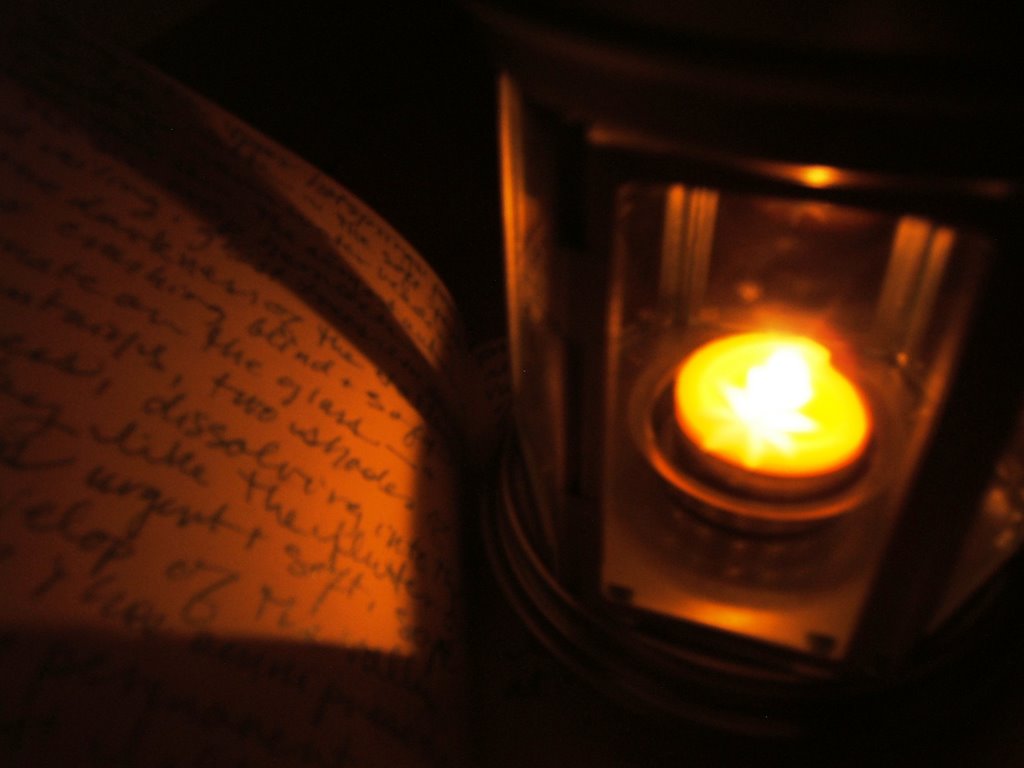
a gallery of sorts

{my notebook & lantern}
Saturday, August 19, 2006
Bili Kvitky, Part 2

{seven o'clock, wandering around the block}
Somehow this story is exactly, precisely August to me, and also perfectly encapsulates and expresses this strange nostalgic sadness I have been feeling.
*
“Can you see me?”
“Yes, I can see you. You are so pale.”
“You cold?”
“No. You?”
“In the morning I have a flight to catch.”
“What? Really?”
“In the morning.”
“Since I’ve been with you, I’ve never been able to understand when you’re joking and when you’re being serious.”
“Where are your eyes? Aren’t you ashamed to talk like this?”
“It wasn’t enough...”
“Don’t talk about it.”
“Put your arms around me...”
*
The row of carts stretched to the river. On the last wagon, on the sacks, a girl stood in a blue-flecked dress of white linen. Behind her, the sun was setting, but it looked as if it were rising.
“Boys, take me for a ride!”
We were already in the boat, I was sitting with the oars on the yellowish water, where the sun was setting as if it were rising.
Pavlo called:
“And where is your old man?”
“Which one?”
“Yours!”
“Dad? Over near the mill.”
“Then come here, we’ll take you.”
I turned the boat to the bank, and gave her my hand. Something flashed, blinding us with a deadly-violet light that illuminated our faces. One of the wires between the poles over the river had dipped into the water.
“It split! The poor devils! It couldn’t have been insulated properly. And that’s all...” mumbled Dmytro, holding onto the girl with his grey stare.
“Don’t rock the boat, don’t rock it!”
“Come off it! Don’t be afraid, or we’ll take you back.”
“Then you better toss me. Row to the bank!” She gazed back at me. “I can’t swim.”
“I can’t swim either, so what?”
“What, you can’t?”
“I can’t. I’m afraid of water.”
“In our village, there is no stream, no pond. Actually, there was once a stream, but they started to drain the bank below the cabbages, it died away. It disappeared somewhere. Now there is neither stream nor cabbages.”
“Poor devils!”
“And where are you from?” Pavlo was pouring himself some horilka[1].
“You know Three-oaks? It’s three kilometres from there.”
“Yes, we know it. Hold on, Vasyl!”
“Pavlo, maybe you should’ve first offered something to our lady? What’s your name?”
“Nastya. But, nothing for me. You go ahead, drink.” She took a glass from Pavlo and passed it to me at the oars.
“Cheers, Nastya.”
“To your health. You want a cucumber, or an onion?”
“Cucumber.”
The girl rinsed a cucumber, and I took a bite from her hand. She salted it, and I took another bite, and another from her hands.
“We had tons of cherries this year, a whole bogful!” But her mention of the cherries was in vain: I didn’t ask for a second cucumber, and she quieted. Only she couldn’t keep her hand still – she placed it on her knee, then on the edge of the boat, and finally dipped it in the water. The sun was setting near her hand, in the amber water.
I said: “Let’s stop near the island, and sit and play some cards.”
“Row on!”
“Do you play, Nastya?”
“Cards? I do. In pairs, or alone. Perhaps, another cucumber?”
“Sure.”
She picked out the largest cucumber, and I took a bite from her golden, dripping hand. Water dripped from her elbow onto my bare foot. Nastya lifted her elbow and droplets fell onto the barrel of the rifle.
“What’s this, your gun?”
“A gun.”
“Last winter the rabbits nibbled ten hectares of apple trees.”
“And you lost the orchard?”
“It was totalled. Maybe a hundred trees survived.”
“Poor devils! Couldn’t wrap up the trees.”
“There wasn’t time. The head of the kolhos[2] was changing.” Nastya laughed. Her dark blue teeth shone delicately in the evening sun.
*
“You aren’t tired yet?”
“No. I must always have you near me. Before, I used to think that I simply couldn’t stand you in large doses. Now, when you weren’t here, I was quietly going crazy.”
“My love, you’ve always been so serious.”
“But not so much that we can’t joke about it, now.”
“True.”
“Do you remember him?”
“Who?”
“Well, the one, as they say, you ‘won me’ from?”
“No. Absolutely not. Not one thing.”
“I trust you in everything. I just don’t know if I can separate lies from truth. I’m afraid –
that I want to believe you, but on the other hand, he was a filthy liar, the one whose face you don’t remember, so now I can’t believe that everything’s good. Or really, I can, but I don’t want to, you know?”
“I understand.”
“And above all, know this. I don’t want to be confused, and I don’t want to believe you for the sake of it being easier and more peaceful. So you mustn’t lie to me, understand?”
“You know me! If I don’t tell lies, I’m not myself. That’s the first thing. The second thing is, lying is easier than speaking the truth. So I’m lying to you. Listen: I have to take a trip.
This time, it’s going to be long, and far. We won’t see each other for a year.”
“A year?”
“A year.”
“And where will you find yourself, my poor thing?”
“Working, dear one, working.”
“You’re leaving me.”
“Today we’ve got summer. So there’s autumn, winter, spring...”
“When we met, I decided to be for you a wife ‘with whom you’d have no trouble’. But you see, I’m neither a wife ‘whom he love’, nor ‘with whom he’s married’, or even a woman ‘with whom he is living.”
“You decided well.”
“I didn’t want you to have to make excuses for yourself, to throw yourself into love, more than you actually were. I wanted that you be with me as you are with yourself – more yourself, even, than you are alone.”
“When we met, I decided to win you away from the one whose face I don’t remember. I remember only you. I was intrigued: Would I win you, or not? The first evening I didn’t succeed, but the second evening I got you.”
“No, love. For me, it was the first evening. Certainly, you fall in love easily, and you can love every time like it’s the first, it’s this I understood that evening and night.”
“Yes, that’s it. What’s this you understood?”
“All the time we’ve had together, from that first evening and night right up until today, I’ve had this feeling that you’re checking on me, and that you don’t love me. You observe me. Often enough, I feel like a rabbit. So, I haven’t become a wife ‘with whom you’d have no trouble’. You see how...”
“I see. And it’s probably true.”
“Don’t run away. Be blunt with me.”
“Maybe, that’s enough about feelings?”
“It’s like you’ve slapped my face.”
“Not bad. Haven’t we got anything to eat? I’m so famished, I’m seeing stars. What have you got there?”
“Macaroni.”
“Well, there’s a meal, God help her. Still, pass it over here.”
“There’s also some of yesterday’s borshch.”
“I don’t want your borshch. You don’t know how to cook borshch. Firstly, you overcook the cabbage. You must put in the cabbage the very last so it stays hard and wiry. And the potatoes must be put in whole, not cut up. And as well as the seasonings, you need to put in some onions. Also whole. They’re sweet when cooked. Well, did I hit you hard?”
“It really doesn’t hurt.”
“ ‘Doesn’t hurt’! If you don’t learn to cook borshch, you’re lost: you don’t know me and I don’t know you. Clear?”
“Clearer than clear.”
“So, give me some macaroni and some of your old leftovers, I’ll eat it, so you won’t need to make such borshch anymore.”
“And who will cook for you on your trip?”
“You actually think that there won’t be anyone?”
“No, dear, there are women more beautiful and wiser that I am – yes, there are. Nearer, dearer, yes. More desirable, oh yes! Only there are none like me, just as there are none like you, understand? That I know, and that’s why I’m so worried by this trip. And I’m concerned about something else...”
“Tell me quickly what’s worrying you, I’m holding my breath! And pass the salt, this macaroni is like grass.”
“Wait. You can laugh later. Yes, I’m worried about something else. I can’t recall the name of the village. That summer we visited old grave mound. We made measurements and surveyed the exterior. Some old men came by, and one told me this: He was digging in his own garden near this mound, and dug up a sealed clay pot. He was overjoyed, he thought it was treasure. He opened it – it was liquid, dark and thick with a gorgeous fragrance. His old buddies came and with his wife they drank it. It was sweet and potent, they were on their knees. They drank it. It was wine. Later, they began to fear they might die. They didn’t. And so as not to test fate, they poured it out, rinsed it, and uncle then filled it with kvas[3]. And later the archaeologists came, and discovered that the pot was three hundred years old... Imagine! These people didn’t know what a rare, old wine they were drinking... So rare....”
“You’ve got a point. But, as you know, I find horilka superior.”
“Don’t evade me. Tell me so: “My darling, there is something in your arguments that won’t let me agree with you.”
“My darling, there is something in your arguments that won’t let me agree with you.”
*
The island was just your ordinary little island; it lived there in the middle of the river, between steep, sun-blanched banks amid its own miniature African jungle of waxy henbane, vigorous thistles, long-maned dogwood, pigweed and marvellous explosions of wildflowers. They shone like palmated, white stars over the pedestrian population of the island and gazed over the world expectant, and uncertain.
Few ever disturbed the island with their visits. Sometimes a gathering of ducks would approach the island, quacking below the hungry dry banks before quickly swimming downstream, into the kingdom of duckweed and willow branches.
“Here.”
With her long, solid legs the girl stepped up on the bank. Her eyes glanced around at the flowers, and quietly passed on to me. The sleepy sunshine fell down onto her shoulders, and her face looked dark against the sun.
I said:
“We’ll eat dinner with the flowers, yes?”
“Shall I go and pick some?”
“Go, but don’t be long.”
“I’ll be just a moment,” she said, not moving from her place. “I’ll be quick,” she said again, and her shadow passed my long evening shadow into the golden henbane.
“Vasyl, look, look!” the boys shouted, grabbing their rifles and crouching down. “Sit, sit down!”
Two ducks were flying our way from the mill. They were far away, and high up, but the sudden whistling of their wings gave our movements a primal instinctiveness, as if we were still neanderthals.
A grey ferociousness shone in Dmytro’s eyes, Pavlo couldn’t sit still, and so he crept off into the pigweed, and then he moved slowly upward through the weeds to the dyke where the ducks were descending. Dmytro rushed after him, drove something sharp into his foot, twitched his leg like a trussed rooster, and disappeared back into the shaggy pigweed.
My rifle looked at me imploringly from the boat, and if it had legs, it would have run after the boys crying: “Wait for me! Those ducks are for me, bang-bang, God help me!”
But here the scent of white flowers came out of the henbane. It came quiet and radiant, brushing my face so calm and light, just touching, then glancing deeply over the dark water, turning it white. The water silvered, shrugged her blue shoulders, and the sun’s rays, caressed in the white breeze, became saturated in whiteness. They floated fragrantly in the dove-coloured evening, over the white houses and above silver Synyukha.
I glanced at the rifle, but I didn’t pick it up. I walked toward the white flowers. My heart was clear and thin as the air, although somewhere in the depths of this clarity awakened a golden trumpet of anxiety. Its empty, sad sound burned in my chest. True, it was late: the trumpet blared in anguish, and the sweet alarm led me along its path, my heart leading me down shoeless and innocent.
The sun was setting as if it were rising, but layers of darkness streamed in the nostalgic air and the world looked like a zebra. Suddenly the girl appeared standing straight before me. In her hands was a bunch of white flowers.
I looked at her between the flowers, and between those white flowers she embraced me. There was a smell of lupines and water. Our heads fell out of the sinking sun.
[1] a grain alcohol, much like whisky or brandy. it burns.
[2] collective farm
[3] a sourish-sweet drink of malt and fermented black rye bread
Sunday, August 13, 2006
Bili Kvitky, Part 1

{profile by the house}
I will present it in two parts. This is the first half (or so); my translation is a little awkward in places but I am definitely pleased with certain paragraphs... though they are not quite as they are in Ukrainian. (You can be very sentimental in Ukrainian and not feel like you are drowning in sap &/or cheese.) So though some of its beauty may not come through, I think I have managed to preserve some of the achy loveliness in a few places.
White Flowers – Mykola Vinhranovskyj
It was still before sorrow. Before the golden farewell of the groves, where the blue poplars blossomed and milkweed lay on the dry banks of the river between the cliffs and the hawthorn; still before the blooming of the vines & wild dog-toothed rose...
*
“Do you want it?”
“No.”
“You do want it.”
“I’m telling you, no.”
“You don’t understand me.”
“I do understand. But, no.”
“No, you don’t understand.”
“Maybe not...”
*
It was still summer. These were quiet days over the steppes, with the calm sky rippling above the water, and perch seen lying on the yellow river bottom.
We were waiting for autumn.
We were returning from Mount Synyukha. On our knees lay shotguns, and with our boat carried by the current, we crunched green onions with our bread; milkweed was blooming, and the sky blossomed neither white nor blue – it was becoming its own colour in this pre-autumnal time when the water flows mournful and transparent, and the birds do not sleep through the night.
*
A droplet fell from the oar.
From the grey bank a heron flew with her chick, circling low over us, and depositing something white near where Dmytro was sitting.
“Would you look at the spot she chose!” Dmytro grabbed his gun and fired. The heron looked back at her young one, waving her wing, and hid herself in the reeds and willows that separated us from the river.
“What if it was on your head?”
“So what?” said Pavlo, biting into a bluish onion. Pavlo had shot two ducks, I – one, and Dmytro, none.
The water quietly rippled against the banks, and there was a smell of gunpowder.
*
“Have you noticed, that every time we have a conversation, I always start talking to you first?”
“Don’t nag me. Honestly – why do you start nagging? Who needs it? No one. Not me, not you.”
“I love you. But you couldn’t care less.”
“No.”
“What’s that – no?”
“That’s right. I don’t care.”
“Don’t lie. You’re lying?”
“Yes, I am.”
“Because you’re a fool, such a fool, and you’re crumbling. Don’t be silly, my darling, don’t be so stupid.”
“All right, I won’t.”
“Don’t laugh! Just don’t laugh, what am I supposed to do if you laugh?”
“All right, all right...”
*
The pike escaped, and Dmytro once more grabbed his gun.
“See if she tries to get away from me again!”
“So what?”
“I’ll show her then!”
“You’ve already said that.” Pavlo was rinsing off a yellow cucumber in the water.
“I’m not a drinker, it’s you guys who choke down that moonshine who do all the bang-bang, and look – something fell on you from the sky.”
“Bang-bang! Bang-bang yourself.”
“Whatever, but I didn’t kill anything.”
“Didn’t kill!”
“So what, you didn’t kill anything.”
“Don’t kill it then.”
“Go to hell! Don’t bug me.”
“Didn’t kill, didn’t kill!”
“That’s right, I didn’t!”
“And what about us, we killed, yes?”
“Vasyl, turn towards the bank, let’s toss this ‘non-killer’!”
“Come on, boys. Really, what the hell for? Look, there’s the dike, get undressed, we’ll tow the boat.”
A second drop fell from the oar.
The rushing of the water, a row of green stones stretched across the river and beyond them, the willows below the reeds – all this was in our view. On the right bank was an antediluvian mill with three black, burnt stories, and a fourth hanging out over the water.
Here, the whole neighbourhood’s grainfields were milled, just as they were every year.
“Don’t rock the boat! Get rid of your pants.”
We undressed, & strode into the water, & the boat touched the dike nose-first.
“Lift it up, lift it!”
“I’m lifting, lift it yourself! What am I, an ox?”
“Turn up the tail-end, the tail!”
The boat went down. Up to our chests in water, we pulled it between the stones to the deeper part of the river, close to the mill.
There was a smell of flour.
From the mill stretched a long line of carts & cars with sacks of grain, and unharnessed horses grazed above the bank. Men were sitting on straw near the wagons, eating supper, playing cards, or drifting off.
*
“And you?”
“As you can hear, I’m not. I can’t sleep.”
“Then what are you doing?”
“Thinking.”
“So am I.”
“About what?”
“About you.”
“Me too.”
“Goodnight, then.”
“Goodnight.”
*
Wild geese in the sky! How long it’s been since I’ve seen wild geese in flight... Wild geese
circling above the mill, sensing the grain... Don’t circle, for your death lies in wait in our boat.
“Give me the gun, give it to me!”
“Let it go.”
Dmytro pushed against the water to the stern, but scraped his foot on an underwater rock and howled like a dog.
I said to him:
“Give it to me, I’m dying to use it.”
“Stop it, shut up.”
“Give me that gun, or I tell you, I’ll kill you.”
“Then just take it, here.”
Dmytro grabbed the gun. Up to his chest in the whirling water, he aimed it at the bellies of the flying geese.
“The water is swaying me, I can’t take aim.”
“Give it to me.”
“Here.”
I fired at these geese, as if they were my tears.
Fly! I don’t need you. I need only myself. For because you exist – the world, and everything else in it exists, and so do I. Fly away, for time is swaying me...